Now Reading: Chike Aniakor: Scholar-Artist of Uli and Igbo Heritage
-
01
Chike Aniakor: Scholar-Artist of Uli and Igbo Heritage


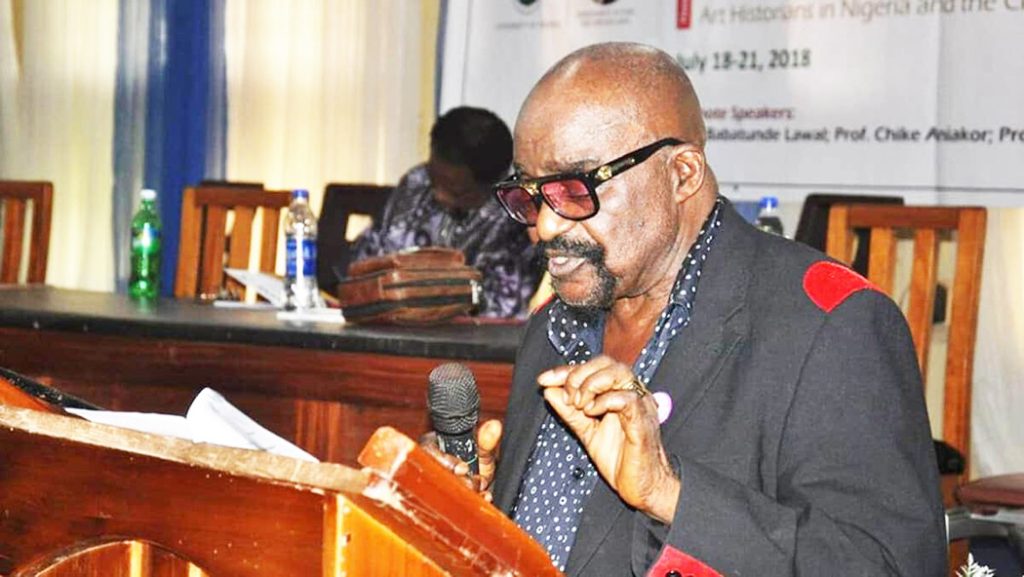
Early Life and Background
Chike Aniakor was born in 1939 in Abatete, Anambra State, Nigeria.
He studied Fine Arts at the University of Nigeria, Nsukka (UNN), where he came under the mentorship of Uche Okeke and became a key figure in the Nsukka School. He later pursued advanced studies, earning a PhD in Art History at Indiana University, Bloomington, USA, with a specialization in Igbo art traditions.
Artistic Career
Nsukka School Artist
Aniakor’s artistic practice centers on the revival and modernization of uli art (the Igbo women’s tradition of body and wall painting).
- He adapted uli line and motifs into modern compositions on paper and canvas.
- His works balance abstraction with figuration, creating scenes that are spiritual, symbolic, and rooted in Igbo cosmology.
- He often uses elongated figures, flowing lines, and delicate motifs to create a sense of rhythm and spirituality.
Style and Themes
- Uli-inspired linearity as his central stylistic language.
- Igbo cultural memory: masquerades, proverbs, and spiritual symbolism.
- Human suffering and resilience, especially influenced by the Nigerian Civil War.
- Spiritual reflection – many works evoke otherworldly calm and ritual solemnity.
Exhibitions
- Exhibited widely in Nigeria, Europe, and the U.S.
- His works are held in international collections such as the National Museum of African Art (Smithsonian Institution, Washington D.C.).
Academic Career
- Served as a professor of Fine Arts at UNN, where he mentored generations of Nigerian artists.
- Specialized in Igbo art history, architecture, and masquerade traditions, publishing extensively on these subjects.
- Contributed to global scholarship on African art as a professor and researcher in the U.S. as well.
Recognition
- Recognized as one of the foremost scholar-artists of Nigeria.
- His dual role as both practicing artist and academic historian has shaped the understanding of uli and Igbo traditions in modern art.
- His works, alongside Obiora Udechukwu and Uche Okeke, established the Nsukka School as a major force in Nigerian modernism.
Legacy
- Custodian of Igbo cultural heritage, ensuring uli remains a living practice within modern art.
- His writings on Igbo masquerades, architecture, and aesthetics are key references in African art history.
- Inspired younger artists (like Tayo Adenaike and El Anatsui at Nsukka) who carried uli-inspired modernism into global recognition.
Conclusion
Chike Aniakor is more than an artist — he is a scholar, teacher, and custodian of tradition. Through his uli-inspired paintings and his academic research, he gave Igbo heritage a modern visual voice and global scholarly platform. His dual contributions place him among Nigeria’s most important artist-intellectuals, bridging practice and history, creativity and knowledge.










Related Posts


Stay Informed With the Latest & Most Important News
Previous Post
Next Post


Advertisement