Nigeria: History
The History of Nigeria
Ancient Empires · Colonialism · Independence · Republic
Journey through millennia of human civilization, from the ancient Nok culture and powerful pre-colonial kingdoms to British amalgamation, the struggle for independence, and the emergence of modern Africa’s largest democracy.
Forging the
Giant of Africa
The entity known today as Nigeria is a modern political creation, but the lands it encompasses have a history stretching back millennia. It was home to some of the oldest human settlements in West Africa, notably the iron-smelting Nok culture.
Before European contact, the region was dominated by sophisticated and powerful states: the trans-Saharan trade hubs of the Hausa Kingdoms and the Kanem-Bornu Empire in the north, the sweeping Sokoto Caliphate, the artistic powerhouse of the Benin Empire, and the sprawling Oyo Empire in the southwest, alongside the highly decentralized democratic societies of the Igbo in the southeast.
The modern borders were drawn by British colonial rule, culminating in the 1914 amalgamation of the Northern and Southern protectorates by Lord Lugard. After achieving independence in 1960, Nigeria navigated a turbulent path of political instability, a devastating Civil War (1967–1970), and three decades dominated by military rule, before stabilizing into the democratic Fourth Republic in 1999.
- Pre-colonial statecraft: Empires, caliphates, and kingdoms.
- Trans-Atlantic Trade & Colonialism: The impact of British imperial policy.
- Nationalism: The diverse voices that fought for self-rule.
- Federalism & Unity: Managing a deeply diverse, multi-ethnic nation.
Defining moments
The turning points that shaped the modern nation
The chapters of history
Click into specific historical periods
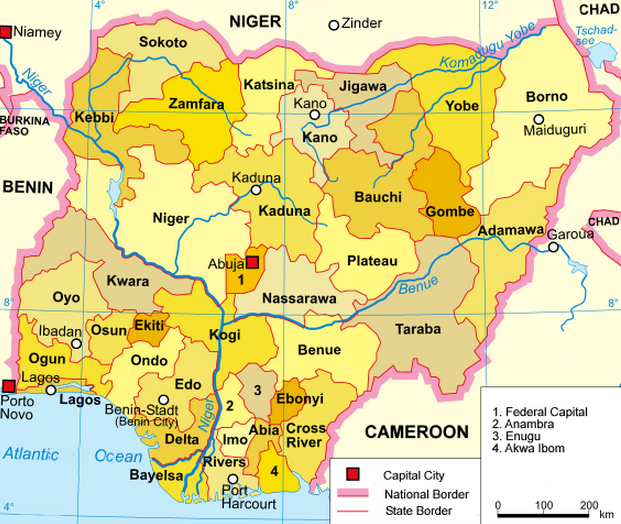
Approximate locations of major pre-colonial empires, kingdoms, and spheres of influence before 1900.
| Nnamdi Azikiwe | First President of Nigeria (1963–1966); leading nationalist. |
|---|---|
| Abubakar Tafawa Balewa | First and only Prime Minister of independent Nigeria. |
| Obafemi Awolowo | Premier of the Western Region; pioneer of federalism & free education. |
| Ahmadu Bello | Sardauna of Sokoto and Premier of the Northern Region. |
| Anthony Enahoro | Moved the first motion for Nigeria’s independence in 1953. |
| Funmilayo Ransome-Kuti | Prominent anti-colonial activist and women’s rights leader. |
| Lord Frederick Lugard | British Governor-General who engineered the 1914 Amalgamation. |
| Flora Shaw | Coined the name “Nigeria” in an 1897 essay for The Times. |
Historical narratives
Snapshots of critical eras shaping the modern nation
Long before British arrival, Nigeria was heavily populated and highly organized. The north featured Islamic scholarly hubs within the Hausa states and the Kanem-Bornu Empire. The south saw the rise of the Oyo Empire with its formidable cavalry, the Kingdom of Benin renowned for its brass casting, and the egalitarian, decentralized societies of the Igbo.
Driven primarily by administrative convenience and economic interests (using southern surpluses to offset northern deficits), the British government merged the Protectorate of Northern Nigeria and the Colony and Protectorate of Southern Nigeria in 1914. This created a single political entity containing hundreds of distinct ethnic groups.
Following post-independence political friction and violent pogroms, the Eastern Region, led by Odumegwu Ojukwu, declared independence as the Republic of Biafra in 1967. The ensuing 30-month civil war was brutally devastating, ending in 1970 with a federal victory and a policy of “No Victor, No Vanquished.”
After decades of interrupted military rule—marked by oil booms, corruption, and the annulment of the June 12, 1993 elections—Nigeria finally transitioned back to civilian governance in 1999 under President Olusegun Obasanjo. The Fourth Republic remains active, representing Nigeria’s most sustained democratic period.
Republics & Regimes
The structure of Nigerian leadership since 1960
| Republic | Years | Key Feature |
|---|---|---|
| First Republic | 1963–1966 | Parliamentary system, British monarch replaced by President. |
| Second Republic | 1979–1983 | Shift to US-style Presidential system (Shehu Shagari). |
| Third Republic | 1993 | Aborted. Elections annulled by military decree. |
| Fourth Republic | 1999–Present | Unbroken civilian rule; multi-party presidential system. |
| Period | Key Leaders | Notes |
|---|---|---|
| 1966–1979 | Ironsi, Gowon, Murtala, Obasanjo | Civil War, oil boom, creation of multiple states. |
| 1983–1993 | Buhari, Babangida | Austerity measures, structural adjustment (SAP), moved capital to Abuja. |
| 1993–1999 | Abacha, Abubakar | Severe political repression, eventual democratic transition. |
| Total time | 29 years | Total time under military rule |