The Nigerian Naira
The Nigerian Naira
Currency · Central Bank · eNaira · Economy
Explore the history, evolution, and economic significance of the Naira (NGN), the official legal tender of the Federal Republic of Nigeria since 1973.
The Lifeblood of the
Nigerian Economy
The Naira (sign: ₦; code: NGN) is the official currency of the Federal Republic of Nigeria. Introduced on January 1, 1973, it replaced the Nigerian pound at a rate of two naira to one pound, marking a significant step in Nigeria’s post-colonial economic independence. The currency is subdivided into 100 kobo.
The sole authority to issue the Naira resides with the Central Bank of Nigeria (CBN), which manages the volume of money supplied in the economy to ensure monetary and price stability. The physical banknotes are printed by the Nigerian Security Printing and Minting Company (NSPMC).
Throughout its history, the Naira has undergone several redesigns and policy shifts—including the transition to polymer substrates for lower denominations and the highly debated 2022 currency redesign. In 2021, Nigeria took a pioneering leap into the future of money by launching the eNaira, Africa’s first Central Bank Digital Currency (CBDC).
- 1973: The Naira replaces the Nigerian Pound. Name coined by Chief Obafemi Awolowo.
- 1999-2005: Introduction of higher denominations (₦100, ₦200, ₦500, ₦1000).
- 2007: Lower denominations (₦5, ₦10, ₦20, ₦50) shifted to polymer notes for durability.
- 2021: Launch of the eNaira digital currency.
Currency Data
A numerical look at Nigeria’s legal tender
Explore the Currency
From physical cash to digital assets
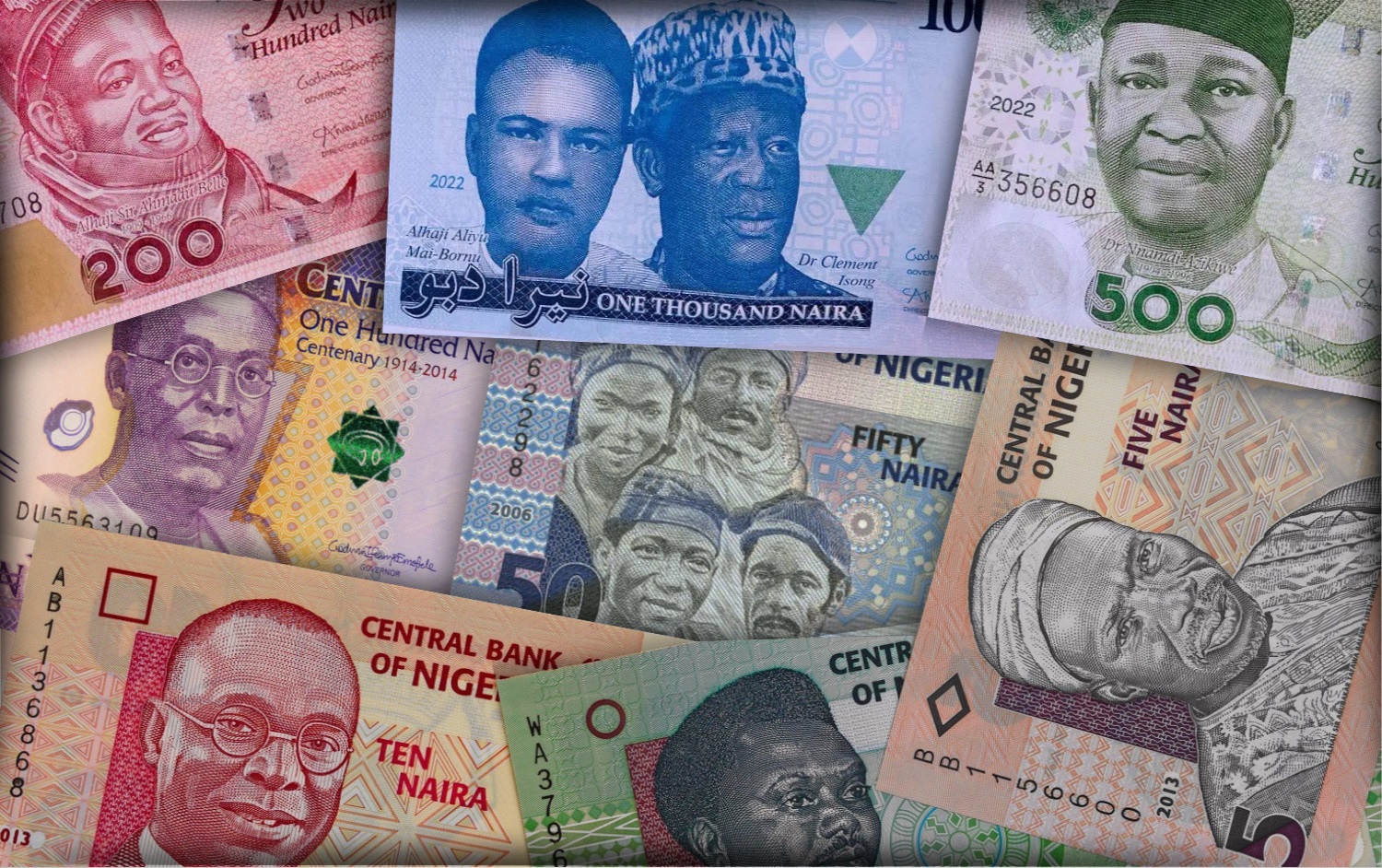
The various denominations of the Nigerian Naira notes, featuring a mix of polymer and paper substrates.
| ₦5 | Alhaji Sir Abubakar Tafawa Balewa (Nigeria’s first Prime Minister). |
|---|---|
| ₦10 | Alvan Ikoku (Educationist) and Fulani milk maids. |
| ₦20 | General Murtala Mohammed (Former Head of State) and Ladi Kwali. |
| ₦50 | Various cultural groups (Wazobia) signifying national unity. |
| ₦100 | Chief Obafemi Awolowo (Nationalist and statesman). |
| ₦200 | Sir Ahmadu Bello (Premier of the Northern region). |
| ₦500 | Dr. Nnamdi Azikiwe (First President of Nigeria). |
| ₦1000 | Alhaji Aliyu Mai-Bornu and Dr. Clement Isong (First indigenous CBN Governors). |
Economy & Evolution
Understanding the mechanics of Nigerian money
The value of the Naira against global currencies (particularly the US Dollar) is a central indicator of Nigeria’s economic health. Historically managed through a pegged or multi-window system by the CBN, recent economic reforms have moved the Naira towards a more market-determined (floating) exchange rate to unify the official and parallel markets.
In late 2022, the CBN initiated a major redesign of the highest denominations (₦200, ₦500, ₦1000). The policy aimed to mop up excess cash outside the banking system, curb counterfeiting, and force a rapid transition to digital banking. Though it caused temporary cash scarcity, it significantly accelerated mobile money adoption.
Launched in October 2021, the eNaira is a central bank digital currency (CBDC) issued by the CBN. It is a direct digital equivalent of the physical Naira. The eNaira aims to lower transaction costs, facilitate easier cross-border trade, and bring millions of unbanked Nigerians into the formal financial sector.
Nigeria has one of the most advanced real-time payment systems in the world, managed by NIBSS (Nigeria Inter-Bank Settlement System). The proliferation of PoS (Point of Sale) agents and USSD mobile transfers has reduced the physical handling of Naira, creating a booming agency banking industry across rural and urban areas.
Historical Timeline
Tracing the evolution of the national standard
| Year | Event | Significance |
|---|---|---|
| 1973 | Introduction of the Naira | Replaced the Nigerian Pound at 2 Naira = 1 Pound. |
| 1999 | ₦100 Note Introduced | First higher denomination to manage inflation. |
| 2007 | Polymer Notes Introduced | Lower notes (₦5-₦50) converted to polymer for durability. |
| 2014 | Centenary ₦100 Note | Special commemorative note issued for Nigeria’s 100th anniversary. |
| 2021 | eNaira Launch | First African CBDC introduced by the CBN. |
| Institution | Role / Mandate |
|---|---|
| CBN (Central Bank of Nigeria) | Apex bank; controls monetary policy, issues the Naira, and manages forex. |
| NSPMC (The Mint) | The Nigerian Security Printing and Minting Company; physically prints the banknotes. |
| NIBSS | Nigeria Inter-Bank Settlement System; handles the infrastructure for digital Naira transfers. |
| NDIC | Nigeria Deposit Insurance Corporation; protects bank depositors’ funds. |