Nigerian Civil War (6 July 1967 – 15 January 1970)
The Nigerian Civil War
Biafra · Conflict · Secession · 1967-1970
Discover the history, causes, and tragic legacy of the Nigerian Civil War, a defining conflict that reshaped the nation’s political and social landscape.
A Nation
Divided
The Nigerian Civil War, also known as the Biafran War, was a bloody and devastating conflict fought from July 6, 1967, to January 15, 1970. The war was the culmination of deep-rooted ethnic, economic, and religious tensions that had been festering since the colonial amalgamation of Northern and Southern Nigeria.
The immediate trigger was a series of military coups and counter-coups in 1966, which led to the massacre of thousands of Igbos in the Northern region. In response, the Military Governor of the Eastern Region, Lieutenant Colonel Odumegwu Ojukwu, declared the region’s independence as the Republic of Biafra on May 30, 1967.
The Federal Military Government (FMG), led by General Yakubu Gowon, launched an offensive to reunite the country. The war became globally notorious for the FMG’s land and sea blockade of Biafra, which led to a catastrophic humanitarian crisis and mass starvation. The conflict ended with Biafra’s surrender and Gowon’s famous declaration of “No victor, no vanquished.”
- Ethnic Tensions: The unnatural borders drawn by British colonizers grouped inherently different nations (Hausa-Fulani, Yoruba, Igbo) into one state.
- Politicization of the Military: The January and July 1966 coups destroyed trust within the armed forces along ethnic lines.
- Resources: The Eastern Region contained the vast majority of the newly discovered, highly lucrative oil reserves.
The Cost of War
Understanding the scale of the tragedy
Phases of the Conflict
From political instability to total war
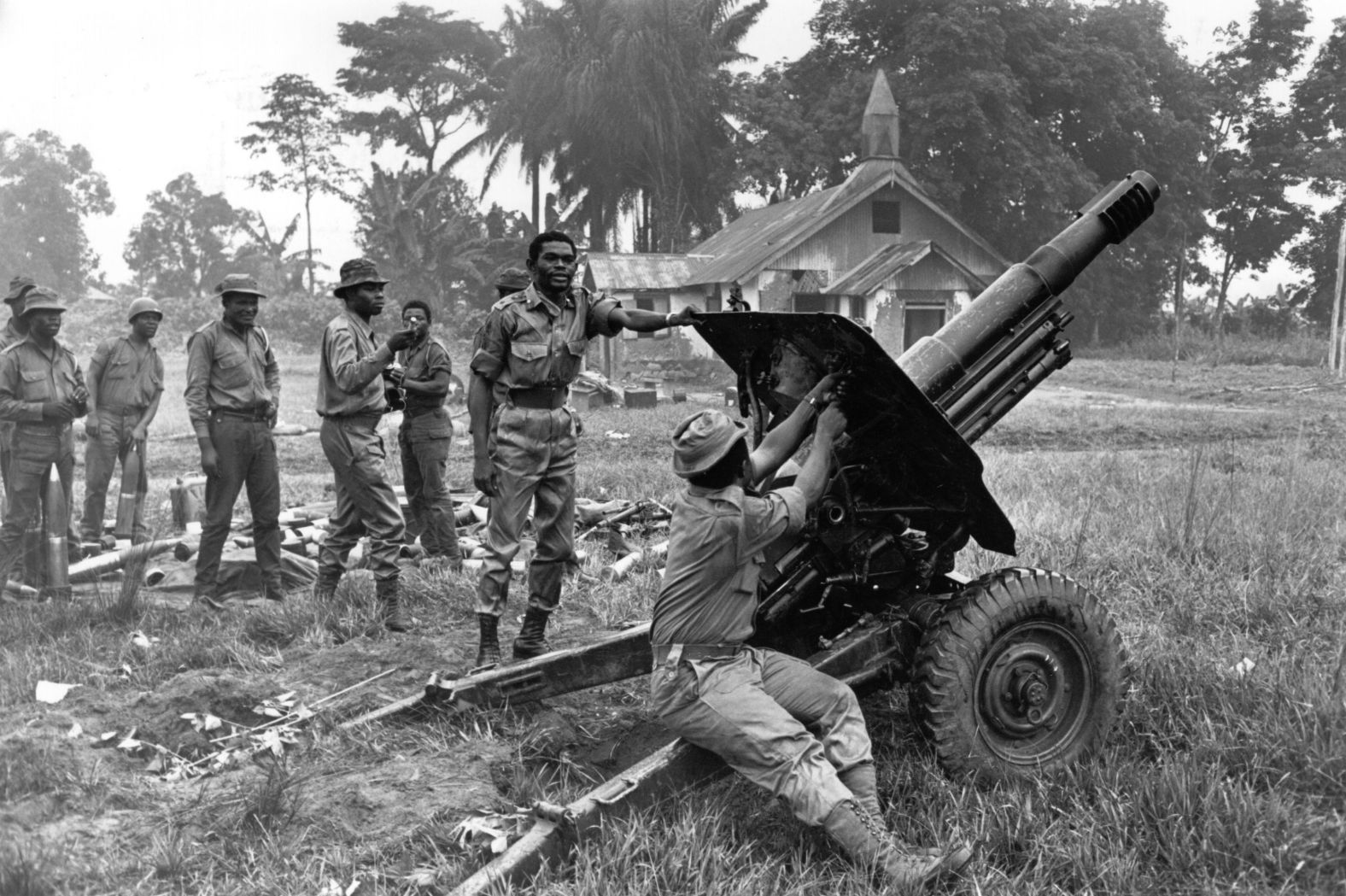
Archival representation of the Nigerian Civil War, a conflict that deeply scarred the nation but forged its modern federal structure.
| Yakubu Gowon | Head of the Federal Military Government; led the war effort to preserve a united Nigeria. |
|---|---|
| Odumegwu Ojukwu | Military Governor of the Eastern Region who declared and led the secessionist Republic of Biafra. |
| Kaduna Nzeogwu | Major who led the January 1966 coup, setting off the chain of events that led to the war. |
| Benjamin Adekunle | “The Black Scorpion,” a fierce and controversial Federal commander of the 3rd Marine Commando Division. |
| Philip Effiong | Chief of General Staff of Biafra; assumed leadership after Ojukwu fled and signed the official surrender. |
Events & Consequences
Crucial moments that defined the war
In January 1967, military leaders met in Aburi, Ghana, in a last-ditch effort to prevent war. Ojukwu argued for a loose confederation, which Gowon initially agreed to. However, upon returning to Lagos, federal civil servants advised Gowon to reject the terms, arguing it would lead to Nigeria’s disintegration. The collapse of the Accord made war inevitable.
In October 1967, Federal troops entered the town of Asaba (in the Mid-Western Region). Believing the townsfolk harbored Biafran sympathies, soldiers gathered the men and boys in a public square and executed hundreds of them. It remains one of the darkest and most controversial atrocities of the war.
The FMG’s total blockade cut off food and medical supplies to Biafra, leading to mass starvation, characterized by images of children with Kwashiorkor. In response, international groups (like Joint Church Aid) organized massive, dangerous night-time airlifts into Uli airstrip, defying the blockade to deliver relief materials.
Following the surrender, General Gowon declared there were no victors and no vanquished. He instituted a policy of “Reconciliation, Rehabilitation, and Reconstruction.” While this prevented immediate post-war reprisals, critics argue the economic policies that followed (such as the £20 flat bank account policy for former Biafrans) deeply impoverished the East.
Timeline & Alliances
Tracing the progression of the conflict
| Date | Event |
|---|---|
| Jan 15, 1966 | First military coup; leaders from the North and West are assassinated. |
| July 29, 1966 | Counter-coup; Ironsi is killed, Gowon takes power. Anti-Igbo pogroms intensify. |
| Jan 1967 | Aburi Accord talks take place in Ghana but ultimately fail. |
| May 30, 1967 | Ojukwu declares the independent Republic of Biafra. |
| July 6, 1967 | Federal troops cross into Biafra; the war officially begins. |
| Jan 15, 1970 | Philip Effiong signs the formal surrender after Ojukwu flees to Ivory Coast. |
| Nation | Stance / Support |
|---|---|
| United Kingdom | Supported the Federal Military Government with heavy arms and logistics. |
| Soviet Union | Supported the FMG, providing fighter jets and military hardware. |
| France | Covertly supported Biafra, supplying weapons through neighboring Francophone countries. |
| Portugal | Supported Biafra by allowing the use of its colonies (Sao Tome) as staging grounds for airlifts. |
| Israel | Initially neutral, later supplied captured Soviet weapons to Biafra. |