Now Reading: The Black President: A Definitive Biography of Fela Kuti
-
01
The Black President: A Definitive Biography of Fela Kuti

I. Origins and Awakening: The Roots of a Rebel
1.1 The Ransome-Kuti Legacy: A Family Forged in Activism
Fela Aníkúlápó Kútì, born Olufela Olusegun Oludotun Ransome-Kuti on October 15, 1938, in Abeokuta, Colonial Nigeria, did not emerge from a vacuum. His origins were rooted in a prominent, upper-middle-class family deeply intertwined with Nigeria’s anti-colonial and nationalist movements. The family was a beacon of intellectual and political resistance. His mother, Funmilayo Ransome-Kuti, was a pioneering anti-colonial feminist, a political activist, and an unwavering advocate for women’s rights. She notably led the Abeokuta Women’s Riots in 1946, a pivotal moment in Nigeria’s struggle for independence. Fela’s father, Israel Oludotun Ransome-Kuti, was an Anglican minister, a school principal, and the inaugural president of the Nigeria Union of Teachers. Both parents played active roles in the anti-colonial movement, a commitment that was underscored by the personal price they paid for their defiance, as evidenced by an incident where Fela’s father was slashed on the face by a soldier for refusing to remove his hat while walking past the British flag.
The family’s influence extended beyond Fela’s parents. His brothers, Beko and Olikoye Ransome-Kuti, were nationally recognized medical doctors, and his cousin was the Nobel Prize-winning writer Wole Soyinka. This background reveals a compelling paradox. While Fela is often portrayed as a radical outsider, his anti-establishment stance was not a rejection of his family’s values but a powerful continuation of them. His mother, in particular, was not merely a backdrop to his upbringing but the bedrock of his ideological formation, a mentor who laid the groundwork for his political consciousness. Her relentless fight against colonial rule and gender discrimination provided a rich narrative that fueled Fela’s lyrics, shaping his worldview and encouraging him to use his music as a vehicle for political expression. Their relationship was symbiotic; Funmilayo’s activism benefited from Fela’s growing fame, while his music was enriched by her experiences and teachings. This intergenerational struggle against oppression shows that Fela’s rebellion was a direct inheritance, not a spontaneous creation, making his life a potent chapter in the larger story of Nigerian liberation.
1.2 The Reluctant Doctor: From London’s Trinity College to the Jazz Scene
Fela’s journey to becoming a musical revolutionary began with an unexpected detour. Raised in an environment that valued both education and discipline, he learned to play piano and drums as a child, skills his father encouraged as part of a proper education. His parents, however, had a different career path in mind, sending him to London in 1958 with the expectation that he would study medicine. This plan, however, was quickly abandoned. With his mother’s “reluctant acquiescence,” Fela enrolled at the Trinity College of Music instead, determined to pursue his passion.
This London period was a crucial crucible for his future identity. He was a diligent student, mastering the trumpet, his preferred instrument. Yet, his formal education was balanced by an equally important “after-hours musical education” in London’s bustling jazz clubs, where he spent significant time jamming with local bands. It was during this time that he formed his first bands, Fela Ransome-Kuti and His Highlife Rakers and later Koola Lobitos, performing a fusion of jazz and highlife. The period was not a simple deviation from his parents’ wishes, but a strategic pivot to a different form of intellectual and cultural work. His father’s encouragement of music as an educational tool meant that Fela was not rejecting his upbringing but was instead choosing a medium that would allow him to be a more effective cultural and political force. His London experience, which exposed him to the improvisation of jazz and the global highlife scene, laid the foundational groundwork for the complex genre he would later create.
1.3 The L.A. Epiphany: A Political and Musical Rebirth
The pivotal moment that transformed Fela’s life and music occurred in 1969, when he and his band, then known as Nigeria 70, embarked on a ten-month tour of the United States. While in Los Angeles, Fela met Sandra Smith, an American musician and activist who was a partisan of the Black Panther Party. Her influence on him was immediate and profound. Fela later acknowledged her as his “adviser” and the one who “opened my eyes” to political history and the Black liberation struggle. She introduced him to the ideologies of revolutionary thinkers such as Malcolm X, Frantz Fanon, and Angela Davis.
This encounter was a political and musical rebirth. It was in Los Angeles that Fela’s music became “increasingly politicized,” shifting from apolitical themes to sharp social critique. He began to see his own experiences of racism in London and America—where he had seen signs reading “No Blacks”—through a new lens of Pan-Africanism and Black Power. The result was not a simple absorption of American ideas but a creative synthesis. He fused the political ideologies of the diaspora with the West African rhythms he had cultivated, birthing the genre of Afrobeat. This moment in Los Angeles created a “circularity of influence,” where a Nigerian musician absorbed American funk and Black Power and then synthesized those elements into a new genre that would, in turn, influence Western artists for generations to come. This experience radicalized his entire identity, transforming him from a musician into an activist with a global, historical vision of African identity.
II. The Rhythm of Resistance: The Genesis of Afrobeat
2.1 The Evolution of a Sound: From Koola Lobitos to Egypt ’80
Fela’s musical career was a continuous evolution, marked by strategic name changes that reflected his deepening political and philosophical commitments. He began with Koola Lobitos, the band he formed in London in 1960, which focused on a fusion of jazz and highlife. This band continued after his return to Nigeria in the mid-1960s and was the crucible for the emerging Afrobeat sound. Following his transformative experience in Los Angeles in 1969, he renamed the band Nigeria 70, a shift that highlighted his newfound nationalistic focus.
The band’s most famous and influential phase began in 1971 when he changed the name to Africa 70, a title that explicitly broadened his message to a Pan-African audience and reflected his growing conviction that the struggle was continent-wide. This band, which included the legendary drummer Tony Allen as musical director, “shot to stardom” and created the definitive Afrobeat sound that would challenge and infuriate the Nigerian government throughout the 1970s. In 1978, after a dispute over fees at the Berliner Jazztage, Tony Allen and nearly all the musicians left the band. This led Fela to form a new group, Egypt 80. The final name change was a significant ideological shift, reflecting a new spiritual direction rooted in Afrocentrism and a reclamation of ancient Egyptian civilization as a source of African strength and identity. Today, this band continues Fela’s legacy under the leadership of his youngest son, Seun Kuti.
| Band Name | Years Active | Key Collaborators | Notable Musical Characteristics | Political/Philosophical Shift |
| Koola Lobitos | 1960–1969 | Ginger Baker, Tony Allen | Highlife and Jazz fusion; early, less overtly political lyrics | Early stage of musical experimentation |
| Nigeria 70 | 1969–1971 | Sandra Izsadore | Incorporation of American funk and Black Power politics | Post-L.A. Epiphany; focus on Nigerian nationalism |
| Africa ’70 | 1971–1978 | Tony Allen, Lester Bowie | Definitive Afrobeat sound; politically charged pidgin lyrics | Broadening of focus to Pan-Africanism |
| Egypt 80 | 1978–1997 | Lekan Animashaun | Continued Afrobeat sound; new spiritual and Afrocentric focus | Deepening of ideology and spiritual identity |
2.2 The Anatomy of Afrobeat: A Musical Weapon
Afrobeat was more than a musical genre; it was a form of political warfare. Fela is widely regarded as its principal architect, having created a unique sound that was both “infectious and thought-provoking”. The genre combines elements of West African music with American funk, jazz, highlife, salsa, calypso, and traditional Yoruba rhythms. The music’s structure itself was a political statement. Songs were characteristically long, often exceeding twenty or thirty minutes in duration, featuring lengthy instrumental jams, exploratory solos, and subtle yet intricate polyrhythms, all of which built a hypnotic, communal groove that physically engaged the audience. This unhurried pace rejected the commercial format of Western pop music, prioritizing the collective experience and the message.
The lyrical content was the music’s most potent weapon. Fela’s songs were filled with “sharp political commentary” and “biting lyricism”. To ensure his message was accessible across the continent’s diverse linguistic landscape, he sang in Pidgin English, a language of the people. His lyrics were not abstract critiques; they directly targeted government corruption, social injustice, human rights abuses, and neocolonialism. This use of music as a vehicle for a popular, anti-establishment message was his primary contribution to both music and political thought.
2.3 The Kalakuta Republic: A Haven of Art and Defiance
In 1970, Fela established the Kalakuta Republic, a communal compound in Lagos that housed his family, band members, and a recording studio. He provocatively declared it an independent state, a direct challenge to the Nigerian military government. The name “Kalakuta” was a satirical nod to the Yoruba word for “rascal” or “a house of chaos,” a name that “perfectly encapsulated the spirit of the place”. This compound was more than a residence; it was a living embodiment of Fela’s ideology, a haven for artistic expression, political activism, and cultural innovation where poets, dancers, and musicians resided and contributed to a vibrant creative scene.
In a separate location, he opened a nightclub, the Afrika Shrine, where he performed regularly and presided over personalized Yoruba traditional ceremonies in honor of his ancestral faith. The Kalakuta Republic and the Shrine became the physical spaces where Fela’s philosophy of Pan-Africanism and decolonization could be lived out every day. This intentional creation of an alternative society made the inevitable state attack on it a symbolic act of war against his very identity and all that it represented.
III. The War for the Soul of a Nation: Fela vs. the Nigerian Military
3.1 Zombie and the Unforgivable Critique
Fela’s confrontational approach reached a new level with the release of his 1977 album, Zombie. The title track used the zombie metaphor to mock the “blind obedience of soldiers” to their superiors, portraying them as mindless automatons who “go, go, go” and “stop, stop, stop” on command. The album was an anthem for a generation disillusioned with the military regime and became a massive success across Africa. The power of Fela’s satire was not just musical but existential. By likening the soldiers to zombies, he stripped them of their dignity and exposed the intellectual hollowness of the military’s authority. This public humiliation, delivered through an infectious and danceable groove, proved more potent and enraging to the government than any abstract political speech.
3.2 The Fire and the Fall: The Brutal 1977 Raid
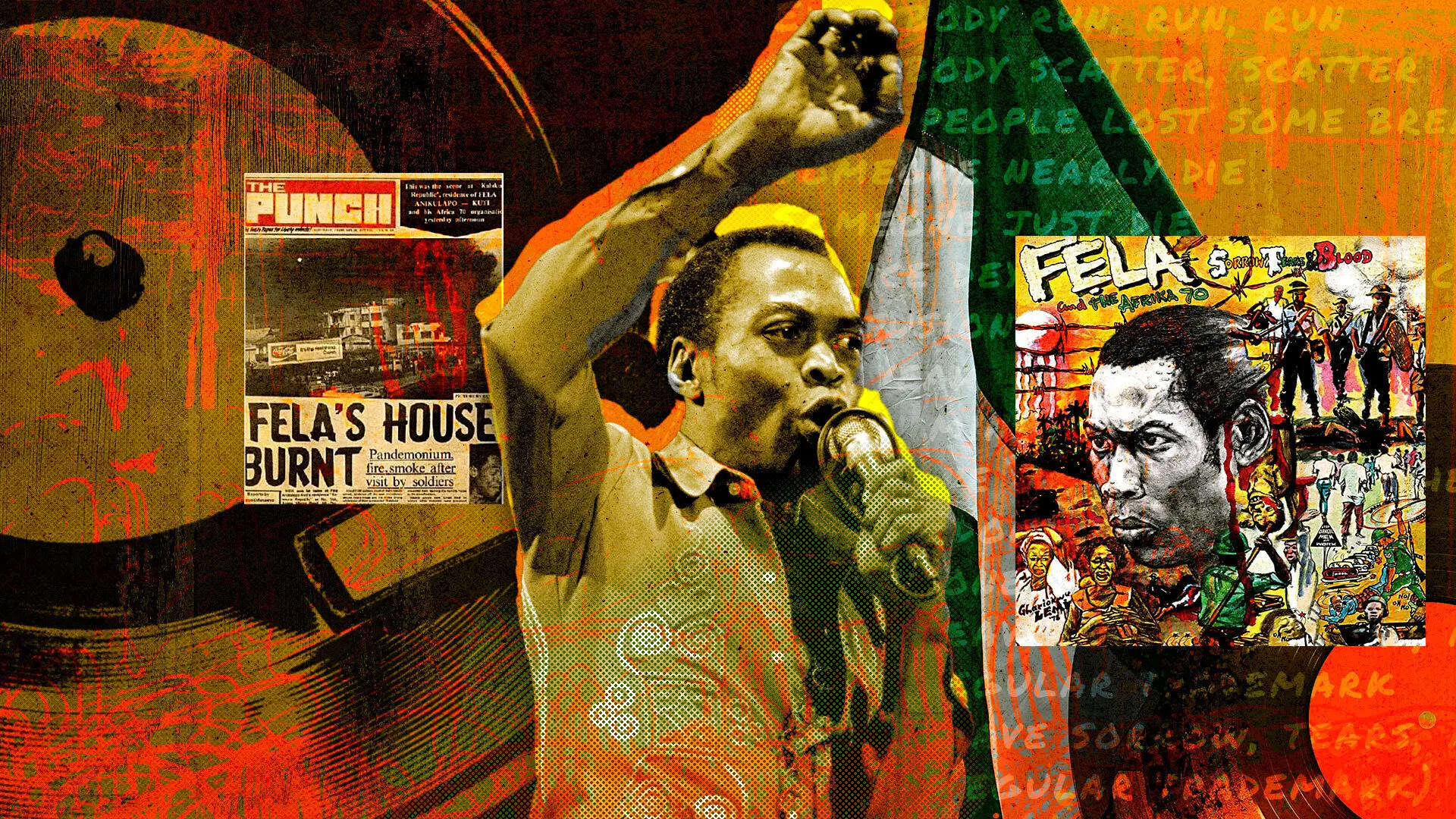
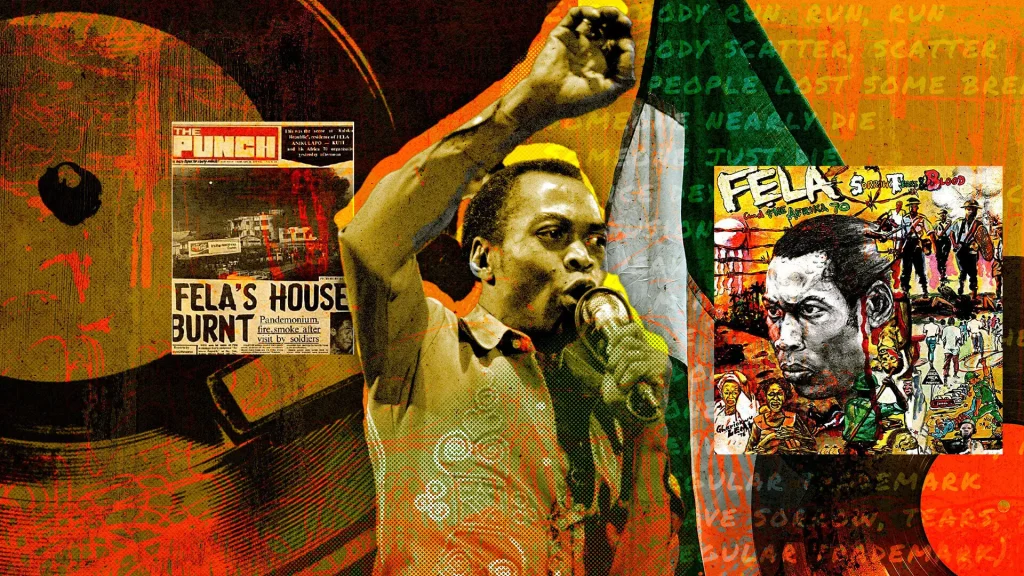
The military’s response to the Zombie album was swift and brutal. On February 18, 1977, a force of 1,000 soldiers raided the Kalakuta Republic. The compound was burned to the ground, and Fela’s recording studio, instruments, and master tapes were all destroyed. During the raid, Fela was severely beaten, and his elderly mother, Funmilayo Ransome-Kuti, was fatally injured after being thrown from a window.
The raid was a pivotal turning point, transforming a personal tragedy into a national symbol of struggle. In a profound act of defiance, Fela delivered his mother’s coffin to the Dodan Barracks in Lagos, the residence of General Olusegun Obasanjo, whom he held responsible for her death. He immortalized the injustice in two songs, “Coffin for Head of State” and “Unknown Soldier,” which referenced the official, legally absurd inquiry that claimed the destruction was the work of an “unknown soldier”. The raid was a desperate attempt to silence him, but Fela’s response proved the state had failed. By publicly holding the government accountable and documenting the lie in his music, he cemented his status as a defiant icon whose art had triumphed over the state’s brute force.
| Album Title | Year of Release | Lyrical Theme/Critique | Specific Political Target/Event |
| Gentleman | 1973 | Ridicules African men who adopt Western clothing and customs in an unforgiving climate | “Colonial mentality” and neocolonialism among the African elite |
| He Miss Road | 1975 | Social critique and satire of national disorder, using traffic as a metaphor for the nation’s struggles | Nigerian national disunity and difficulty adhering to a vision of unity |
| Zombie | 1976 | Mocks the blind obedience and lack of independent thought of soldiers | The Nigerian military regime and military oppression |
| Sorrow, Tears and Blood | 1977 | Denounces the brutal violence and impunity of the military’s actions | The aftermath of the raid on the Kalakuta Republic |
| Unknown Soldier | 1979 | Criticizes the government’s official inquiry that claimed an “unknown soldier” destroyed Kalakuta | The government of General Olusegun Obasanjo |
| Coffin for Head of State | 1980 | Holds the head of state responsible for his mother’s death | General Olusegun Obasanjo and the 1977 raid |
| Original Sufferhead | 1981 | Addresses the problem of water scarcity and corruption | Government corruption and social injustice |
| Beasts of No Nation | 1989 | Directly attacks President Buhari, mocking his speech about the Nigerian people | The military government of Muhammadu Buhari |
3.3 A Litany of Persecution: Over 200 Arrests
Throughout his life, Fela was an “outspoken critic and target of Nigeria’s military juntas”. He was arrested more than 200 times and had to appear in court 356 times for criticizing the government’s corrupt activities. This relentless persecution, from the 1974 jail sentence that inspired the album
Expensive Shit to his imprisonment by the Muhammadu Buhari government in 1984, shows the state’s obsession with silencing him. The government used the legal system not for justice but as a tool to harass and exhaust him, bringing forward charges ranging from currency smuggling to murder, which were eventually dropped.
Fela’s international fame made this persecution a double-edged sword for the government. His arrest in 1984 led to him being named a “Prisoner of Conscience” by Amnesty International, drawing global attention to his plight. The Nigerian state was caught in a paradoxical situation: it needed to maintain the illusion of law and order to manage dissent, but its heavy-handedness against a globally famous figure only amplified his message and garnered him more international support. Each arrest served to harden Fela’s resolve and further solidify his status as a political martyr in the eyes of his supporters.
IV. The Man and the Myth: Navigating Controversy and Complexities
4.1 The Politics of the Personal: Anikulapo and the Rejection of a “Slave Name”
Fela’s personal life was inseparable from his politics. In 1975, he made a powerful statement by changing his surname from “Ransome-Kuti” to “Anikulapo-Kuti,” dropping the “Ransome” because he considered it a “slave name”. This was not a casual rebranding but a profound act of personal decolonization, a public rejection of the European framework and a reclamation of an authentic African identity. The new surname, “Anikulapo,” meaning “He who carries death in his pouch,” was a spiritual and metaphysical assertion of his autonomy. It was a declaration of fearlessness and self-determination: “I will be the master of my own destiny and will decide when it is time for death to take me”. This re-naming was a fundamental act of defiance that intertwined his personal beliefs with his public struggle against oppression.
4.2 Polygamy, Power, and Patriarchy: A Complex Exploration
Fela’s life was marked by a central contradiction: he was a fiercely progressive Pan-Africanist and anti-colonial revolutionary, yet his personal views on women and polygamy were widely seen as regressive. In 1978, he married 27 women in a single, traditional Yoruba ceremony, many of whom were dancers and singers in his band. He later claimed the act was a form of protection against authorities’ false claims that he was kidnapping the women and an anniversary tribute to the 1977 raid on Kalakuta. He later adopted a rotation system for his 12 wives.
Academic analysis of Fela’s work and life acknowledges his misogynistic views, citing the lyrics of songs like “Lady” and “Mattress” and his unapologetic interviews. However, a full understanding of his actions requires a deeper look at the context. Some scholars suggest that Fela’s public display of polygyny was a “strategically enacted” act of defiance against the Western, monogamous standards imposed by colonialism. He saw monogamy as a colonial imposition and a system that facilitated deception, arguing that men should bring all their lovers “in the house, man, to live with him, and stop running around the streets!”. This view presents a central paradox: his polygamy was simultaneously a political statement of nationalist defiance and an expression of a deeply patriarchal worldview. This complexity is often simplified by Western media, which uses his polygamy to stereotype African masculinity as “dangerously hyper-sexual”. A nuanced biography must acknowledge his regressive views on women while also recognizing his polygamy as a performative act of anti-colonial resistance.
4.3 The Rebuilt Shrine and the Movement of the People
After the 1977 raid, Fela was undeterred. He and his band, Africa 70, moved to the Crossroads Hotel before he eventually rebuilt the Kalakuta Republic in Ikeja, where he would live until his death in 1997. He also established the new Afrika Shrine, a vibrant nightclub where he continued to perform and hold his personalized Yoruba traditional ceremonies. This venue became his permanent podium for social and political commentary, where he would perform from midnight until the early hours of the morning.
In 1979, Fela took his resistance to the next level by forming his own political party, the Movement of the People (MOP), with the stated aim of “cleaning up society like a mop”. He ran unsuccessfully for the presidency of Nigeria, but his candidacy was refused by the government. The formation of MOP marked a significant shift from cultural activism to overt political action, demonstrating Fela’s decision to directly challenge the state through its own electoral process. However, the government’s refusal to let him run showed the limits of his influence; they were willing to tolerate his music as a “pressure valve” for public dissent but would not allow him to enter the formal political arena, thus revealing the authoritarian nature of the state.
V. The Enduring Beat: Fela’s Legacy and Posthumous Reign
5.1 The Inherited Crown: Femi and Seun Kuti Carry the Torch
Fela Kuti’s legacy is not a static artifact but a living, evolving body of work carried forward by his family. His sons, Femi and Seun Kuti, both renowned musicians, have inherited their father’s artistic and political fire. Femi leads his own band, The Positive Force, and Seun took over the leadership of his father’s former band, Egypt 80, after Fela’s passing. They have continued to use their platforms for activism, championing human rights and actively campaigning against corruption and social injustice, just as their father did.
In a crucial and telling evolution of the legacy, Fela’s sons have also taken up new “millennial concerns,” such as climate change, environmental protection, and, most notably, LGBT rights. Femi and Seun have publicly supported LGBT rights, a stance that has drawn “a predictable barrage of vitriol” from social and religious conservatives in Nigeria. Seun has explicitly stated that his father would not have supported Nigeria’s anti-gay law, noting that gay people lived in their Kalakuta Republic home. This shows a generational evolution of Fela’s core philosophy. The sons have taken his principles of human dignity and freedom and applied them to new social justice issues, proving that the enduring power of Fela’s message lies in its core principles, which can be reinterpreted and applied to new struggles for a new generation.
5.2 A Global Influence: From Hip-Hop to Broadway
Fela’s influence has transcended Nigeria to become a profound global force. His music has inspired contemporary artists worldwide, including African superstars like Burna Boy, Wizkid, and Davido, as well as international acts like Erykah Badu, Mos Def, J. Cole, and Coldplay. The fusion of West African rhythms with American funk and jazz has been adopted by musicians across genres, leading to a rich cross-cultural exchange. His music has been widely sampled by hip-hop and rap artists, and DJs continue to mix his tracks to create new forms of dance music like Afro-house.
Fela’s collaborations during his lifetime, though few, were notable and influential, including working with renowned artists like Ginger Baker, Lester Bowie, and Roy Ayers. His legacy has also been preserved and expanded through new media forms. The award-winning Broadway musical
Fela! (2008) and documentaries like Finding Fela (2014) and Music Is The Weapon (1982) have introduced his story to a vast international audience. These cultural tributes have solidified his place in history not just as a musician but as a political and cultural pioneer whose influence continues to resonate with oppressed people worldwide, proving that his artistic vision was a blueprint for modern resistance.
5.3 The Living Legacy: Institutions and Tributes
Fela’s legacy is physically embodied in a number of institutions in Nigeria, most of which were founded and are managed by his children. Felabration, a week-long annual musical event conceived by his eldest daughter Yeni, celebrates Fela’s life and music every October. This festival has become an official tourist destination for the Lagos State Government and attracts thousands of visitors from around the world. The New Afrika Shrine, built by Femi and Yeni Kuti, serves as a popular venue where his sons perform regularly, keeping the spirit of the original club alive.
Perhaps the most poignant tribute is the Kalakuta Museum, located in Fela’s former home in Ikeja, Lagos. The three-story house has been preserved as a museum, packed with his personal belongings and artifacts from his life and career, including his shoes, shirts, instruments, and his preserved bedroom. The fact that the Lagos State Governor provided funding for this museum is a powerful and ironic statement on the normalization and institutionalization of his revolutionary fire. The anti-establishment rebel who was jailed over 200 times and had his home burned down is now a state-sanctioned icon and a celebrated tourist destination, a testament to the fact that his message was so potent it could not be eradicated by force.
5.4 The Final Salute: The 2025 Grammy Hall of Fame Induction
The ultimate vindication of Fela Kuti’s art as a historical force came in his posthumous induction into the 2025 Grammy Hall of Fame for his 1976 album, Zombie. The Grammy Hall of Fame honors recordings that are at least 25 years old and have “lasting qualitative or historical significance”. The Grammy announcement explicitly cited
Zombie for its “fearless critique of oppression, cultural impact, and enduring relevance to political resistance and African musical heritage”. This marks the first time a Nigerian artist has received this honor, permanently cementing Fela’s legacy not just in musical history but into world history.
The induction of the very album that provoked a violent military raid and led to his mother’s death is a profound full-circle narrative. It proves that the state’s attempt to silence him failed completely. The military raid on Kalakuta Republic was meant to destroy his ideology, but instead, it became a part of the history of the album that is now being globally celebrated. This final accolade is not just an award; it is a historical declaration that Fela’s art, born from suffering and defiance, has triumphed over the forces that sought to destroy it. It is a timeless testament to the power of music as a weapon for truth and justice.
| Name of Tribute/Accolade | Year | Type of Medium | Significance |
| Fela! (Musical) | 2008 | Broadway musical | Brought Fela’s story to a massive international audience, winning multiple Tony Awards and a Grammy nomination for its soundtrack. |
| Felabration | 1998–Present | Annual music festival | An annual week-long event that celebrates Fela’s life and music in Nigeria, founded by his daughter Yeni Kuti. |
| The New Afrika Shrine | 2000 | Nightclub/venue | A venue built and run by his sons Femi and Seun, which serves as a cultural hub and a direct tribute to the original club. |
| The Kalakuta Museum | 2012 | Museum/cultural institution | Located in his former home, it preserves Fela’s personal artifacts and life, transforming the site of a brutal raid into a historical landmark. |
| Grammy Hall of Fame | 2025 | Award | The posthumous induction of the album Zombie for its historical significance and enduring relevance, making Fela the first Nigerian artist to receive this honor. |
VI. Conclusion
Fela Aníkúlápó Kútì’s life was a complex tapestry woven from music, politics, family, and profound defiance. He was a man of immense contradictions—born into privilege yet a fierce anti-establishment populist, a Pan-African revolutionary whose views on women were a source of controversy, and a political dissident who used the tools of his persecutors to his own advantage. His musical career was a direct reflection of his ideological evolution, from the jazz and highlife of his London years to the Pan-Africanist fervor of Africa 70 and the Afrocentrism of Egypt 80. The creation of Afrobeat was not a random act but a deliberate forging of a musical weapon, with its lengthy grooves and Pidgin lyrics serving as a populist platform for his sermons on justice and freedom.
The Nigerian military’s relentless persecution of Fela, culminating in the brutal 1977 raid on the Kalakuta Republic and the death of his mother, ultimately backfired. The state’s attempts to silence him only amplified his voice and transformed his personal tragedy into a universal symbol of resistance. This is the central narrative of his biography. He refused to be a victim, instead immortalizing his suffering in songs that served as a historical record of the government’s abuses. In death, Fela’s legacy has proven to be an unstoppable force, a fact demonstrated by the preservation of his life’s work in museums and festivals and his children’s continuation of his fight for social justice. The posthumous Grammy Hall of Fame induction of his album Zombie, the very music that provoked the state’s violence, is the ultimate testament to the triumph of his art over the forces that sought to destroy it. Fela’s life shows that in the face of tyranny, music can be a more enduring and powerful weapon than any military force.Sources used in the report










Related Posts

Stay Informed With the Latest & Most Important News
Advertisement