Now Reading: An Exhaustive Analysis of Nigerian Wealth: From Industrial Titans to Digital Innovators
-
01
An Exhaustive Analysis of Nigerian Wealth: From Industrial Titans to Digital Innovators
An Exhaustive Analysis of Nigerian Wealth: From Industrial Titans to Digital Innovators

The landscape of Nigerian wealth is a complex and paradoxical phenomenon, characterized by a high concentration of capital among a small number of industrial and financial titans. This report analyzes the dynamics of this elite wealth, distinguishing between an “old guard” of billionaires whose fortunes were forged in capital-intensive sectors with deep ties to the state and a “new wave” of tech and fintech entrepreneurs who represent a more globalized, innovation-driven model of wealth creation. This report demonstrates that the immense fortunes of the former are often built through a transactional relationship with the government, which can stifle competition and hinder broad-based economic growth. In stark contrast, the latter’s success is a product of solving market inefficiencies and attracting private venture capital, offering a potential path to a more inclusive economy.
By contextualizing this elite wealth against a backdrop of a vast, under-utilized informal economy and volatile macroeconomic conditions, the report highlights the extreme disparity between the affluence of the few and the economic hardship faced by the many. A comparative analysis with South Africa and Egypt reveals Nigeria’s unique position on the continent, where its massive population and large nominal GDP are undermined by low per capita income and significant structural constraints. This report synthesizes biographical data, financial records, and economic indicators to provide a nuanced understanding of how wealth is created, deployed, and perceived in Nigeria, ultimately concluding that a shift towards a meritocratic, innovation-driven economic model is essential for the nation’s future prosperity.
Chapter 1: The Architecture of Nigerian Wealth: A Profile of its Leading Figures
This chapter provides a detailed examination of the key individuals who define Nigeria’s billionaire and multimillionaire class, distinguishing between established figures and emerging innovators.
1.1 The “Old Guard”: Industrial Titans
The foundation of Nigeria’s wealth elite is comprised of a cohort of industrialists who built their empires through large-scale, capital-intensive ventures. Their business model is characterized by vertical integration and market dominance within foundational sectors of the Nigerian economy.
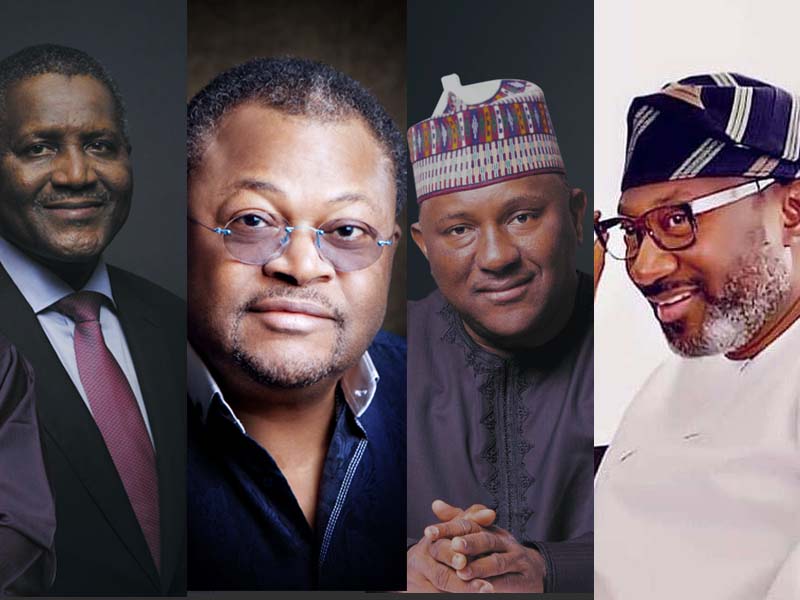
Aliko Dangote: The Apex of Industrial Power. As Africa’s richest person, Aliko Dangote’s profile is central to any discussion of Nigerian wealth. His fortune, estimated at $24.4 billion in one source and $23.9 billion in another, is a testament to the scale of his Dangote Group empire. His business model is a masterclass in industrial dominance, built on holding an 85% stake in publicly-traded Dangote Cement, the largest cement producer on the continent. The company has the capacity to produce 48.6 million metric tons annually and operates in 10 countries across Africa. Dangote’s wealth narrative is not static; it is a dynamic story tied directly to macro-economic events and strategic projects. For instance, his net worth experienced a significant surge, from $13.9 billion in 2024 to $23.9 billion in 2025, a spike directly attributed by Forbes to the valuation of his new Dangote Refinery, which began refining operations in early 2024. Conversely, a weakened Nigerian currency has been shown to pull down the value of his fortune, illustrating the inherent volatility and dependence on national economic conditions.
Mike Adenuga: The Conglomerate King. Mike Adenuga’s wealth is rooted in a highly diversified portfolio. He is the chairman of Globacom, Nigeria’s second-largest telecommunications operator, and also holds stakes in the oil exploration firm Conoil. The biographical information on his wealth creation notes its origins in telecommunications and oil, with some reports also citing real estate as a source of his fortune. This demonstrates a strategy of empire-building across multiple, high-value sectors.
Abdulsamad Rabiu: The BUA Group. Similar to Dangote, Abdulsamad Rabiu’s fortune is built on a conglomerate, the BUA Group, with core businesses in cement production, sugar refining, and real estate. His business strategy has been one of consolidation; in early 2020, he merged his privately owned Obu Cement company with the publicly listed Cement Co. of Northern Nigeria, a firm he already controlled. The combined entity, BUA Cement Plc, solidifies his power in the cement industry, an approach that mirrors the dominant tactics of his industrial contemporaries.
Femi Otedola: The Strategic Investor. Femi Otedola’s wealth narrative is defined by strategic market timing and a willingness to pivot between industries. A billionaire who made his initial fortune in petroleum, Otedola later sold his assets in Forte Oil to focus on the power generation sector. He is the current executive chairman of Geregu Power PLC and holds a significant position of influence in the financial sector as the chairman of First Bank of Nigeria (FBN) Holdings Plc. This transition from oil to power demonstrates a deep understanding of Nigeria’s evolving economic landscape and a strategic focus on sectors critical to national infrastructure.
Table 1: Top Nigerian Billionaires: Wealth, Industries, and Trends (2014-2025)
| Name | Net Worth (2025 USD) | Net Worth (2024 USD) | Net Worth (2022 USD) | Net Worth (2020 USD) | Net Worth (2014 USD) | Primary Sources of Wealth |
| Aliko Dangote | $23.9 billion | $13.9 billion | $13.9 billion | $8.3 billion | $25 billion | Cement, Sugar, Oil & Gas, Diversified |
| Mike Adenuga | $6.8 billion | $6.8 billion | $5.7 billion | $5.7 billion | $4.6 billion | Telecommunications, Oil, Real Estate |
| Abdulsamad Rabiu | $5.1 billion | $5.1 billion | $6.7 billion | $3.1 billion | $2.5 billion | Cement, Sugar, Real Estate |
| Femi Otedola | $1.5 billion | $1.5 billion | N/A | N/A | $1.0 billion | Finance, Oil, Power |
| Folorunsho Alakija | N/A | N/A | N/A | N/A | $2.5 billion | Oil, Fashion |
Note: N/A indicates the individual was not listed in the top billionaires for that specific year and source.
1.2 Emerging Wealth: The New Economy Innovators
In contrast to the traditional model, a new class of wealth is emerging from the technology and financial sectors. These innovators are building wealth not on industrial assets and political connections but on solving global problems and attracting private venture capital.
Tope Awotona (Calendly): The Diaspora Success Story. Tope Awotona, a Nigerian-American, founded Calendly, a scheduling software company now valued at $3 billion. His story is a powerful example of modern entrepreneurship. He started the company by self-funding it with his entire life savings of $200,000, driven by his personal frustration with inefficient meeting scheduling. He later secured a substantial $350 million investment, which propelled the company’s valuation. His success is a product of creating a globally relevant software solution, not by leveraging local resources or state-owned enterprises.
Shola Akinlade (Paystack) & Olugbenga Agboola (Flutterwave): The Fintech Revolutionaries. The success of these two fintech giants, both valued in the billions of dollars, represents a powerful alternative to the traditional wealth model. Shola Akinlade’s company, Paystack, was acquired by the global payments firm Stripe in a deal reported to be worth approximately $200 million. Similarly, Olugbenga Agboola’s Flutterwave became Africa’s most valuable startup after a $250 million funding round in 2022 valued it at over $3 billion. The foundation of these companies was laid by addressing a fundamental inefficiency in the Nigerian economy: complex and difficult payment processing. These stories highlight a model of wealth creation driven by innovation, a focus on digital platforms, and the ability to attract global private equity.
Chapter 2: The Dynamics of Wealth Creation: Old Systems and New Frontiers
This chapter delves into the underlying mechanisms that enable the accumulation of immense wealth in Nigeria, from political connections to technological innovation.
2.1 The Nexus of Business and State: A Critical Analysis
The relationship between Nigeria’s business elites and the state is a significant factor in the country’s wealth distribution. For many of the “old guard,” success is not merely a function of market competition but of strategic political relationships.
The Dangote Case Study. Aliko Dangote’s rise to prominence is deeply intertwined with political support. He was a “key supporter” of President Olusegun Obasanjo’s 2003 re-election campaign, contributing over N200 million. Critics allege that in exchange, he was granted “exclusive” import rights for cement, sugar, and rice, and that the government’s Backward Integration Policy (BIP) disproportionately benefited politically connected elites like himself, stifling competition and creating monopolies. This model, where access to government contracts, import permits, and subsidies serve as the building blocks of billion-dollar empires, is a common feature of the Nigerian business landscape. The research indicates that Dangote has also been appointed to various government advisory roles, including President Goodluck Jonathan’s economic management team and President Muhammadu Buhari’s re-election campaign advisory team. The very essence of this system is that success is often achieved by building alliances with the powerful, a dynamic that can reward loyalty over competition and lead to economic inefficiencies.
The fortunes of politically connected individuals can have a negative impact on national economic growth, as they often rely on market distortions that benefit a few at the expense of the broader population. By granting protective policies and monopolies, the state hinders the development of a competitive market, which in turn harms smaller enterprises and keeps consumer prices high. This dynamic creates a direct link between the concentrated wealth of the elite and the widespread lack of economic opportunity for the majority, a paradox of concentrated prosperity amid persistent poverty.
2.2 Foundational Industries: The Engines of the Old Guard
The primary sources of wealth for Nigeria’s industrial titans are concentrated in sectors that are crucial to the country’s infrastructure and basic needs.
Cement and Industrial Dominance. The cement industry, in which both Dangote and Rabiu are dominant figures, is a perfect illustration of the backward integration model in action. The Dangote Group transitioned from a trading-based business to a full-fledged manufacturing operation in the late 1990s, acquiring the state-owned Benue Cement Company and commissioning a massive cement plant. This move made Dangote central to Nigeria’s infrastructure development and solidified his position in the industry.
Oil & Gas and Energy. The oil sector has historically been a traditional route to wealth, as seen in the fortunes of Mike Adenuga and Folorunsho Alakija. The research highlights a stunning disconnect between Nigeria’s natural resources and its fiscal health, with over 3.5 billion barrels of untapped oil reserves and a projected national budget deficit of N13 trillion. This indicates that wealth creation in this sector is not a systemic benefit for the nation but a highly extractive activity that benefits a few well-positioned individuals.
2.3 The Rise of Tech and Finance: New Wealth Models
In a powerful counter-narrative to the old system, new wealth is being created in the tech and financial services sectors, which are less reliant on government patronage.
Banking as a Financial Backbone. The careers of bankers like Pascal Dozie and Aigboje Aig-Imoukhuede showcase the role of strategic mergers and acquisitions in building financial empires. Aig-Imoukhuede, for example, led the acquisition of a small regional player, Access Bank, and transformed it into one of the country’s largest financial institutions. This financial expertise serves as a foundation for broader investment activities through holdings like Coronation Group and Tengen Family Office.
Fintech as a Disruptor. The stories of Tope Awotona (Calendly), Shola Akinlade (Paystack), and Flutterwave represent a new wealth model built on a market-first approach. Their success is driven by identifying and addressing consumer and business inefficiencies, a strategy that has attracted global venture capital rather than relying on government licenses or contracts. This model is built on a global, rather than exclusively local, market, showcasing a clear divergence from the industrialist playbook.
Chapter 3: The Social Footprint: Philanthropy, Power, and the Paradox of Disparity
This chapter explores the public-facing aspects of Nigeria’s wealthy elites, examining their philanthropic efforts and their broader social and political influence.
3.1 The Billionaire Philanthropists: An Examination of Key Foundations
The philanthropic activities of Nigeria’s wealthy are a critical component of their public identity. These efforts, however, are driven by different motivations and strategies.
The Dangote Foundation. As the largest private foundation in Sub-Saharan Africa, the Aliko Dangote Foundation (ADF) is a significant entity with a mission to improve health, education, and economic empowerment. Its stature is cemented by its high-profile partnership with the Bill and Melinda Gates Foundation to eradicate polio in Nigeria. The ADF’s humanitarian efforts also include contributing N2.5 billion to a flood relief committee, an amount higher than the combined contributions of Nigeria’s 36 state governors.
The Tony Elumelu Foundation (TEF). Tony Elumelu’s TEF is a unique model of philanthropy, championing an economic philosophy he calls “Africapitalism,” which posits that the private sector and entrepreneurs are the catalysts for the continent’s development. The foundation’s flagship program is a 10-year, $100 million commitment to identify, train, mentor, and fund 10,000 young African entrepreneurs across 54 countries. His efforts are a direct and strategic attempt to address youth unemployment and foster a new generation of business leaders.
Femi Otedola’s Personal Philanthropy. Femi Otedola’s memoir, Making It Big, offers a deeply personal look into his philanthropic motivations. He recounts a period of immense debt (N220 billion) that led him to make a spiritual vow to God, which he later fulfilled by donating billions of naira to various causes. His N5 billion donation to Save the Children in 2019, for example, was a direct result of his daughter’s advocacy and her report on an internally displaced persons’ camp. This demonstrates that his philanthropy is not simply a business strategy but a personal and spiritual act of gratitude.
Table 2: Key Philanthropic Contributions of Femi Otedola (2004-2023)
| Year | Donation Amount (NGN/USD) | Beneficiary/Cause | Source |
| 2004–2008 | N200 million ($1.4 million) | Sir Michael Otedola Scholarship Awards | |
| 2005 | N300 million ($2.5 million) | National Ecumenical Centre, Abuja | |
| 2019 | N5 billion ($14 million) | Save the Children Fund | |
| 2019 | N391 million ($1 million) | African Centre, New York | |
| 2023 | N2 billion ($2.1 million) | Faculty of Engineering, Augustine University | |
| 2023 | N1 billion ($1.2 million) | Scholarships for Augustine University students |
3.2 Power and Influence: The Role of Wealth in Governance
The influence of Nigeria’s wealthy goes beyond philanthropy; it extends into the corridors of power. The relationship between business and politics is often conducted through back-channels, but occasionally, it is brought into the public sphere.
The case of Tony Elumelu offers a rare public glimpse into this dynamic. His public criticism of government policies, questioning how a country so rich in resources could have 90% of its citizens living in poverty, stands in contrast to the typical private engagement of other billionaires. This public stance, which was seen by some as an “indiscretion,” may signal a subtle shift in how some elites are engaging with systemic issues, particularly when those issues, such as oil theft, threaten their business interests. The public conversation, however, often simplifies a complex system where political connections often override merit, and the real business happens behind closed doors, a reality that understanding this dynamic is essential for any aspiring entrepreneur.
Chapter 4: Nigeria’s Economic Standing: A Comparative Analysis within Africa
This chapter places Nigeria’s wealth in a macro-economic context, comparing its economic structure and challenges to those of its continental rivals, South Africa and Egypt.
4.1 Reconciling Conflicting Economic Metrics
The public narrative on Nigeria’s economic size is often contradictory. Some sources claim that the Nigerian economy has risen to become the biggest in Africa by nominal GDP. However, other data from the World Bank and IMF show South Africa with a higher nominal GDP in 2024 and 2025. This discrepancy can be attributed to the volatility of the Nigerian Naira and the different methodologies used for calculation. The most reliable data points are those that contextualize nominal GDP with other key metrics.
The most telling data point is Nigeria’s low GDP per capita, which stood at only $807 in 2024, a small fraction of South Africa’s $6,253. This single metric most powerfully illustrates the extreme disparity between the wealth of Nigeria’s elite and the economic reality of its broader population. When adjusted for purchasing power parity (PPP), which accounts for the cost of living, Nigeria’s GDP rises significantly, but it is still eclipsed by Egypt’s in the same category.
4.2 The Role of the Informal Economy and Structural Challenges
A key differentiator between the Nigerian and South African economies is the size of their informal sectors. Nigeria’s informal sector accounts for a significant 68% of its labor force, compared to South Africa’s 17%. While this large informal sector contributes to Nigeria’s low official unemployment rate, it also masks widespread underemployment and low productivity. This creates a major systemic challenge, as a large portion of the economy operates outside the tax base, weakening the state’s ability to collect revenue and provide essential services.
Nigeria’s economic potential is further constrained by a range of structural barriers. The nation’s positive growth outlook is contingent upon tackling issues such as inadequate infrastructure, particularly an unreliable power supply, trade barriers, and a generally unfriendly business environment. The inability to sustain consistent growth has resulted in a slow reduction in poverty rates compared to other African countries with similar growth trajectories.
4.3 Benchmarking Nigeria against its Continental Rivals
The three economic giants of Africa—Nigeria, South Africa, and Egypt—each have a unique economic profile.
South Africa: Diversified but Highly Unequal. South Africa’s economy is the most industrialized and technologically advanced on the continent. It is highly diversified, with services contributing over 62% of its GDP and strong financial and mining sectors. However, it is plagued by high unemployment (31.9% in 2024) and extreme inequality, driven in large part by the legacy of apartheid, which created disparities in access to education, land, and labor markets.
Egypt: Complexity over Volume. While Nigeria’s total export volume is higher ($61 billion in 2023), Egypt’s Economic Complexity Index is significantly better. This indicates a more sophisticated and less resource-dependent economy, with a diversified base in tourism, agriculture, and emerging technology sectors. When measured by GDP (PPP), Egypt consistently ranks as the richest African country, reflecting a lower cost of living and a well-developed mixed economy.
Table 3: Comparative Economic Indicators: Nigeria vs. South Africa vs. Egypt (2024)
| Country | Nominal GDP (2024, million USD) | GDP per capita (2024, USD) | Population (2024, millions) | Unemployment Rate (2024, %) | Economic Complexity Index (2023) |
| South Africa | 410,338 | 6,397 | 64.0 | 33.2 | -0.11 |
| Nigeria | 188,271 | 807 | 232.7 | 3.0 | -1.75 |
| Egypt | 347,342 | 3,174 | 109.5 | N/A | -0.11 |
Note: Unemployment data for Nigeria may be distorted by the large informal economy.
Chapter 5: Conclusion and Strategic Outlook
The analysis of Nigerian wealth reveals a profound and fundamental paradox. On one hand, the country is home to some of the most affluent individuals on the continent, whose fortunes rival those of global titans. Their success, exemplified by the “old guard,” is a product of navigating a system where political connections and strategic control of foundational industries have created immense, concentrated wealth. This model, while effective for a select few, has demonstrably contributed to market inefficiencies and inhibited inclusive economic growth. The concentration of power and capital has created an environment where competition is often stifled and the benefits of economic activity do not permeate to the broader population.
On the other hand, the emerging “new wave” of tech and fintech billionaires represents a potential paradigm shift. Their success, built on innovation, problem-solving, and the ability to attract global private capital, is less dependent on the traditional patronage system. This model offers a blueprint for a more diversified, meritocratic, and globally integrated economy. The future of Nigerian wealth depends on which of these two models prevails.
For Nigeria to achieve sustainable, inclusive growth, a strategic shift is required. The nation must move away from an economic structure that rewards political access and industrial monopolies and towards one that incentivizes genuine innovation and market competition. This requires a determined effort to formalize the large informal sector, improve critical infrastructure, and strengthen institutions to build a more transparent and predictable business environment.
The story of Nigeria’s billionaires is more than just a collection of individual success stories; it is a mirror reflecting the nation’s broader economic and political landscape. The contest between the “old guard” and the “new wave” is a microcosm of the country’s struggle to transition from a resource-dependent, politically-influenced economy to a diversified, innovative, and more inclusive one. The trajectory of Nigerian wealth will be a key indicator of the nation’s future.










Related Posts


Stay Informed With the Latest & Most Important News
Previous Post
Next Post

Advertisement