Now Reading: Ben Enwonwu: Nigeria’s Legendary Modernist Artist
-
01
Ben Enwonwu: Nigeria’s Legendary Modernist Artist
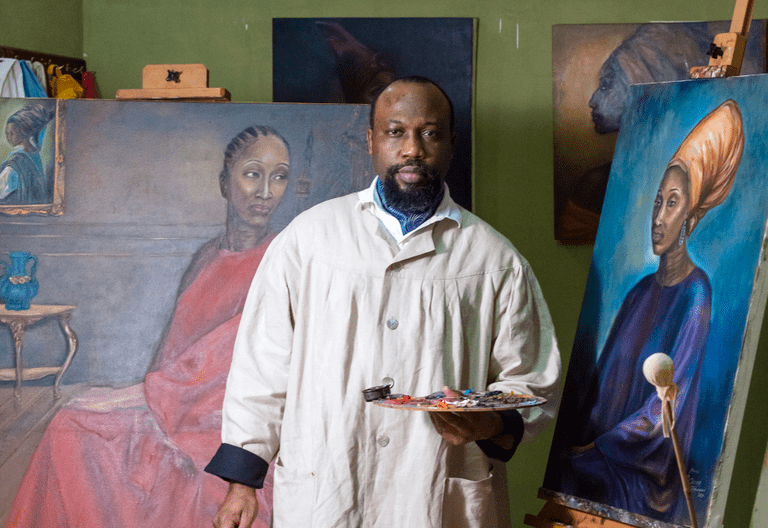

Early Life and Background
Benedict Chukwukadibia Enwonwu (MBE) was born on 14 July 1917 in Onitsha, Eastern Nigeria, into a family of traditional artists. His father was a sculptor who worked in the Igbo carving tradition, an influence that shaped Enwonwu’s later fusion of African aesthetics with Western modernism.
He studied at Government College, Umuahia, where his artistic talent was nurtured by Kenneth C. Murray, a British art teacher who promoted indigenous Nigerian art. Enwonwu later attended Achimota College, Ghana, before moving to the U.K. in 1944 to study at the Slade School of Fine Art, University College London.
Artistic Career
Rise to Prominence
By the late 1940s, Enwonwu was already exhibiting internationally. His works combined Igbo traditional forms with European modernist techniques, creating a unique African modernist style.
In 1956, he was commissioned to sculpt a statue of Queen Elizabeth II, which solidified his global reputation.
Philosophy of Art
Enwonwu believed art was a tool of cultural independence, capable of countering colonial stereotypes. He blended modernist ideas with African traditions, creating works that embodied Nigerian identity in a global context.
Iconic Works
- “Anyanwu” (1954): His most famous bronze sculpture, installed at the Nigerian National Museum in Lagos. Inspired by Igbo earth goddess figures, it symbolizes African freedom and resilience.
- “Tutu” (1974): A portrait of Princess Adetutu Ademiluyi of Ife, often referred to as the “African Mona Lisa.” The painting became a symbol of Nigerian cultural pride and resurfaced in 2018, selling at auction for over £1 million.
- Portrait of Queen Elizabeth II (1956): A high-profile royal commission.
Other notable works include landscapes, portraits, and public monuments across Nigeria and abroad.
Style and Themes
- Synthesis of African tradition and European modernism.
- Themes of identity, freedom, and dignity.
- Celebrated African women and figures of power.
- Worked across painting, sculpture, and public art.
Enwonwu’s art was both aesthetic and political — a cultural assertion during and after colonial rule.
Honors and Recognition
- Appointed Member of the Order of the British Empire (MBE) in 1955.
- Nigeria’s first art adviser (1948–1954).
- Served as a UNESCO art consultant.
- Works exhibited worldwide, including at the Tate Gallery, London.
- Considered the most influential African artist of the 20th century.
Later Life and Death
Enwonwu continued to work and teach until his death on 5 February 1994 in Lagos.
Legacy
- Known as the “Father of African Modernism.”
- His work paved the way for later Nigerian artists such as Bruce Onobrakpeya and Yusuf Grillo.
- His painting Tutu remains a cultural icon, representing Nigerian identity on the global stage.
- His influence continues through the Ben Enwonwu Foundation, which promotes art education and preservation.
Conclusion
Ben Enwonwu was more than an artist — he was a cultural diplomat, nationalist, and visionary, who used his art to merge tradition with modernity and assert Africa’s place in world art. From Anyanwu to Tutu, his works continue to inspire pride and admiration, ensuring his status as Nigeria’s greatest modernist artist.










Related Posts

Stay Informed With the Latest & Most Important News
Previous Post
Next Post
Previous Post
Next Post
Advertisement