Nnamdi Azikiwe
Zik of Africa · First President · Nationalist · Journalist
Discover the life and legacy of Dr. Nnamdi Azikiwe, the pioneering journalist and statesman who led Nigeria's struggle for independence and became its first President.
The Father of
Nigerian Nationalism
Benjamin Nnamdi Azikiwe, affectionately known globally as "Zik of Africa", is widely celebrated as the driving force behind modern Nigerian nationalism and the nation's independence from British colonial rule. A towering intellectual, he combined the power of the press with fierce political advocacy to unite a fragmented nation.
Educated in the United States, Azikiwe returned to West Africa with a profound Pan-African vision. Through his newspaper, the West African Pilot, he fearlessly criticized colonial policies and championed the rights of the African working class. He later co-founded the National Council of Nigeria and the Cameroons (NCNC), leading the political charge that ultimately secured Nigeria's sovereignty in 1960.
Following independence, Azikiwe served as the Governor-General, and when Nigeria became a Republic in 1963, he was sworn in as its first President. Though the title was largely ceremonial within the parliamentary system, his influence as the patriarchal figure of a free Nigeria remained absolute.
- Spiritual Balance: Emphasized self-respect and the shedding of the colonial inferiority complex.
- Social Regeneration: Advocated for dropping tribal prejudices in favor of national and pan-African unity.
- Economic Determinism: Pushed for African self-reliance and control over domestic resources.
- Political Resurgence: The ultimate goal of total sovereignty and democratic governance for the continent.
The Nationalist in Data
Key milestones of a historic life
Explore the Legacy
The many roles of Dr. Azikiwe
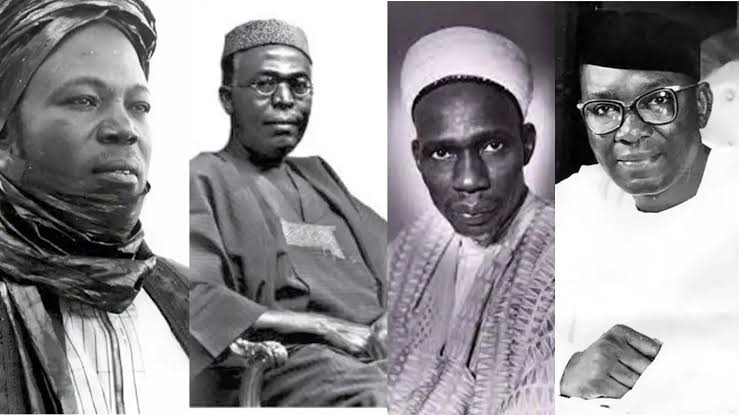
Dr. Nnamdi Azikiwe, a charismatic leader whose powerful oratory and journalism galvanized the Nigerian independence movement.
| Chief Obafemi Awolowo | Leader of the Action Group (AG). Chief political rival of Azikiwe and champion of federalism and Western region development. |
|---|---|
| Sir Ahmadu Bello | Sardauna of Sokoto and leader of the Northern People's Congress (NPC). Formed an independence coalition with Azikiwe's NCNC. |
| Sir Abubakar T. Balewa | Nigeria's first and only Prime Minister. Head of the federal government during Azikiwe's ceremonial presidency. |
| Herbert Macaulay | Founder of Nigerian nationalism. Azikiwe's mentor and the original founder of the NCNC. |
| Anthony Enahoro | The young nationalist who famously moved the first motion for Nigeria's independence in 1953. |
Politics, War & Philosophy
The defining eras of Azikiwe's leadership
Founded in 1937, Azikiwe's newspaper, the West African Pilot, revolutionized journalism in the region. Unlike older, conservative papers, the Pilot was aggressively anti-colonial, explicitly political, and targeted the average African worker. It served as the primary mouthpiece for the nationalist movement.
To secure independence in 1960, Azikiwe's largely Southern-backed NCNC formed a controversial but necessary coalition with the Northern-backed NPC (led by Ahmadu Bello). This alliance allowed Abubakar Tafawa Balewa to become Prime Minister, while Azikiwe accepted the role of Governor-General, and later, ceremonial President.
During the Nigerian Civil War (1967-1970), Azikiwe initially supported the secessionist Republic of Biafra and acted as a roving ambassador for the Igbo people. However, in a highly controversial move in 1969, he switched sides, calling for an end to the rebellion and urging a "One Nigeria" to prevent further bloodshed.
Believing that true independence required intellectual freedom, Azikiwe spearheaded the creation of the University of Nigeria, Nsukka (UNN) in 1955 (opened in 1960). It was designed on the American educational model, emphasizing practical, vocational, and indigenous knowledge over the classical British system.
Historical Timeline
Key dates in the life of Zik of Africa
| Year | Event | Significance |
|---|---|---|
| 1904 | Birth | Born in Zungeru, Northern Nigeria. |
| 1925 | US Education | Travels to the US, attending Storer College, Lincoln Univ., and UPenn. |
| 1934 | Return to Africa | Edits the African Morning Post in the Gold Coast (Ghana). |
| 1937 | West African Pilot | Founds his highly influential nationalist newspaper in Lagos. |
| 1944 | NCNC Founded | Co-founds the National Council of Nigeria and the Cameroons with Herbert Macaulay. |
| 1954 | Premier of the East | Becomes the Premier of the Eastern Region. |
| Year | Event | Significance |
|---|---|---|
| 1960 | Independence | Nigeria gains independence; Azikiwe appointed Governor-General. |
| 1963 | First Republic | Nigeria becomes a republic; Azikiwe becomes its First President. |
| 1966 | Military Coup | Ousted from power during the bloody January 15 military coup. |
| 1979 | Second Republic | Runs for president under the Nigerian People's Party (NPP) but loses to Shehu Shagari. |
| 1996 | Death | Passes away at the age of 91 in Enugu. |
Historical Archives
See also & internal links
Go deeper