The Flag of Nigeria
Green & White · Peace & Agriculture · 1960
Explore the history, symbolism, and protocol of Nigeria's national flag, a timeless emblem of peace, unity, and the nation's immense agricultural wealth.
A symbol of
unity and wealth
The National Flag of Nigeria is an elegant, minimalist emblem consisting of three vertical bands of equal width: green on the hoist and fly sides, and white in the center. First hoisted at midnight on October 1, 1960, it replaced the British Blue Ensign to mark the dawn of an independent Federal Republic.
The flag was designed in 1959 by Michael Taiwo Akinkunmi, who was a 23-year-old engineering student at Norwood Technical College in London at the time. After seeing a newspaper advertisement calling for a national flag design, he submitted his concept, which beat out nearly 3,000 other entries to become the winning design.
The brilliance of the flag lies in its simplicity and profound symbolism. The two green stripes represent Nigeria's lush vegetation, abundant agricultural resources, and natural wealth. The central white stripe stands for peace, unity, and the pure waters of the River Niger and River Benue flowing through the nation.
- Akinkunmi's original submission included a red radiating sun in the white center.
- The sun was intended to symbolize divine protection and a bright future.
- The judging committee removed the sun to ensure the flag remained as simple and widely reproducible as possible.
Historical Timeline
The journey of the Green-White-Green
Understanding the Emblem
Rules, variations, and the story of its creation
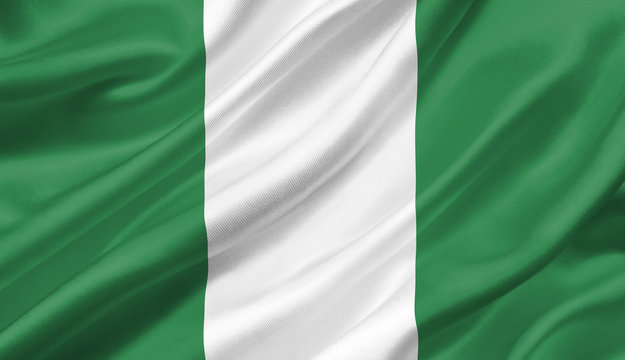
The Green-White-Green national flag of Nigeria flying high, symbolizing natural wealth and unity.
| Nigeria Green | A standard, deep shade of green meant to evoke lush vegetation. |
|---|---|
| HEX Code (Green) | #008751 (Approximate standard) |
| RGB Code (Green) | 0, 135, 81 |
| CMYK Code (Green) | 100, 0, 39, 47 |
| HEX Code (White) | #FFFFFF |
| RGB Code (White) | 255, 255, 255 |
| CMYK Code (White) | 0, 0, 0, 0 |
Protocol & Variations
Handling the flag with national respect
The national flag must be treated with the utmost respect. It should be hoisted briskly at dawn (6:00 AM) and lowered slowly at dusk (6:00 PM). It must never touch the ground, be used as clothing, or be displayed in a faded or torn condition. When worn out, it should be destroyed privately and respectfully, usually by burning.
The President of the Federal Republic uses a special variant of the national flag. This state flag is identical to the standard Green-White-Green but features the Nigerian Coat of Arms positioned squarely in the center of the white stripe. It is flown wherever the President is present.
The Nigerian Armed Forces use specific ensigns based on British traditions. The Nigerian Army uses a red flag with the national flag in the canton (upper left) and the Army emblem. The Navy uses a white ensign with the national flag in the canton and the naval seal, while the Air Force uses a light blue ensign.
On days of national mourning, as declared by the Federal Government, the flag is flown at half-mast. To do this correctly, the flag must first be hoisted to the very top of the peak before being lowered to the halfway point. It must be raised to the top again before being lowered for the day.
Historical Timeline
Tracing the evolution of the national standard
| Year | Flag Used | Description |
|---|---|---|
| Pre-1914 | Company Flags | Used by the Royal Niger Company (featuring a Y-shape for rivers). |
| 1914-1960 | Colonial Blue Ensign | British Blue Ensign defaced with the badge of Nigeria (a green Star of David). |
| 1960 | Current Flag | Green-White-Green officially raised at Tafawa Balewa Square. |
| Detail | Fact |
|---|---|
| Organizer | National Planning Committee for Independence |
| Total Entries | Approximately 2,870 submissions |
| Winning Designer | Michael Taiwo Akinkunmi |
| Original Element | Red Sun in the center (removed by judges) |
| Prize Awarded | £100 |
Civic Data
See also & internal links
Go deeper