Now Reading: Peju Alatise: Nigeria’s Visionary Artist of Myth and Social Justice
-
01
Peju Alatise: Nigeria’s Visionary Artist of Myth and Social Justice
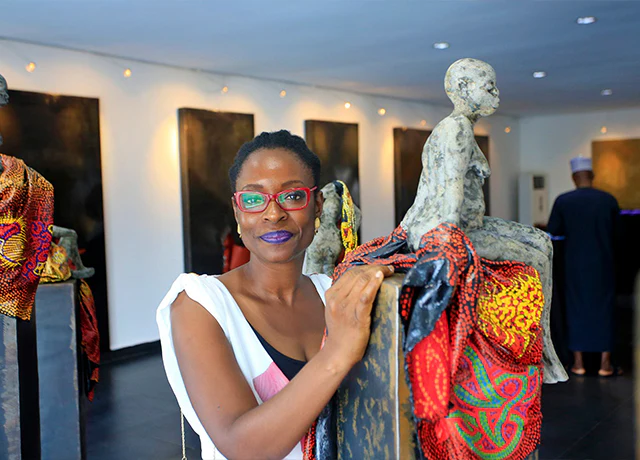

Early Life and Background
Peju Alatise was born in 1975 in Lagos, Nigeria. She studied architecture at Ladoke Akintola University of Technology, where she trained as a professional architect before transitioning into full-time studio art.
Her multidisciplinary background in architecture, literature, and visual art gave her a unique foundation to experiment across sculpture, installation, painting, and writing.
Career and Artistic Practice
Interdisciplinary Artist
For over two decades, Peju Alatise has been an interdisciplinary artist, poet, novelist, and architect, creating work that blends Yoruba mythology with urgent social and political commentary.
Her art frequently addresses issues of:
- Child marriage and gender inequality
- Child labor and domestic servitude
- Trauma and resilience of Nigerian women and girls
- Myth, spirituality, and Yoruba cosmology
Notable Works
- Flying Girls (2017): Exhibited at the Venice Biennale, this installation of winged girl sculptures was inspired by the story of a ten-year-old domestic maid who dreams of flight. It symbolized empowerment and the hope for freedom.
- Nine-Year-Old Bride (2013): A haunting sculpture protesting child marriage, created during heated national debates on the issue.
- Wrapture (2013): A groundbreaking exhibition combining short stories and sculptural installations, where literature and visual art merged into one narrative.
Exhibitions and Recognition
- One of the first Nigerian artists to exhibit at the Venice Biennale (2017), alongside Victor Ehikhamenor and Qudus Onikeku.
- Exhibited internationally in Europe, the U.S., and Africa, gaining recognition as one of Africa’s leading contemporary artists.
- Winner of the FNB Art Prize (2017, South Africa).
Writing
Peju Alatise is also a writer and poet. Her short stories and poems often echo the same themes found in her visual work — mythology, gender, and social critique. Her project Wrapture is a perfect example of her cross-disciplinary storytelling.
Activism and Advocacy
Beyond the studio, Alatise is deeply engaged in activism:
- Vocal advocate for the “Child Not Bride” movement in Nigeria.
- Addresses child labor and women’s rights through her art.
- Founder of the ANAI Foundation, which trains and supports young Nigerian visual artists through workshops, mentorship, and residencies.
Style and Themes
- Yoruba mythology infused into contemporary narratives.
- Use of mixed media — resin, fiberglass, textiles, and found objects.
- Large-scale installations that combine beauty with protest.
- Deep concern with the female body, freedom, and transformation.
Awards and Recognition
- FNB Art Prize (2017).
- Smithsonian National Museum of African Art Fellow.
- International recognition as one of the foremost Nigerian women artists of her generation.
Legacy and Influence
Peju Alatise is celebrated as one of Nigeria’s most daring and visionary artists, bridging the worlds of myth and reality, literature and sculpture, activism and beauty.
Through her art, she challenges patriarchy, fights for children’s and women’s rights, and uses storytelling to empower the silenced.
Conclusion
Peju Alatise is not only an artist but a storyteller, activist, and cultural architect. With works like Flying Girls and Nine-Year-Old Bride, she has placed Nigerian contemporary art at the heart of global conversations on justice and imagination. Her art is both a protest and a dream — a vision of a world where Nigeria’s girls can fly free.










Related Posts


Stay Informed With the Latest & Most Important News
Previous Post
Next Post

Advertisement