Now Reading: The Igbo Kingdom of Nri: A Theocratic Paradigm of Pre-Colonial Influence and Pacifism
-
01
The Igbo Kingdom of Nri: A Theocratic Paradigm of Pre-Colonial Influence and Pacifism
The Igbo Kingdom of Nri: A Theocratic Paradigm of Pre-Colonial Influence and Pacifism

1. Introduction: A Civilization of Spiritual Authority
The Kingdom of Nri, or Ọ̀ràézè Ǹrì in Igbo, was a medieval polity located in what is now southeastern Nigeria. This state stands as a unique historical entity, distinguished from many other pre-colonial African empires that relied on military conquest and expansion through force. Instead, the Kingdom of Nri existed as a “sphere of religious and political influence” that extended over a significant portion of what is known today as Igboland. It was administered by a priest-king, the
Eze Nri, who managed diplomacy and trade and held supreme divine authority in religious affairs.
Reconstructing the history of Nri presents a notable academic challenge, as it is a narrative woven from a blend of oral tradition, archaeological discoveries, and later written accounts from the colonial era. Oral history, preserved through storytelling and cultural ceremonies, provides a spiritual and social framework for the kingdom’s founding and governance. This narrative is complemented by archaeological evidence, particularly the renowned Igbo-Ukwu artifacts, which offer a tangible glimpse into the civilization’s material wealth and antiquity. By carefully reconciling these different sources, a comprehensive understanding of Nri’s profound and unique historical trajectory can be achieved.
2. The Divine Origins and Historical Foundation
The Founding Myth of Eri, the ‘Sky Being’
The historical narrative of the Kingdom of Nri is anchored in the founding myth of a divine figure named Eri. According to legend, Eri was a ‘sky being’ sent by the supreme deity, Chukwu, to establish civilization on Earth. The oral tradition recounts his descent to a watery, marshy land where he sat on an anthill. When he complained to Chukwu, a blacksmith from Awka was sent down with his tools to dry the earth with fiery bellows and charcoal. This foundational act not only made the land habitable but also conferred authority, symbolized by the
ọfọ given to the blacksmith for his profession. This story establishes a profound link between divine intervention, labor, and the creation of societal order, an ideology that would come to define the kingdom’s identity.
Tracing Lineage and the Umu-Eri Clan
Eri is regarded as the patriarchal figure from whom the Umu-Eri clan traces its lineage. His descendants, including his sons Agulu (founder of Aguleri) and Menri (founder of Umunri/Kingdom of Nri), established communities that formed the core of the Nri civilization. This shared mythological origin explains the close relationship between Nri and neighboring communities like Aguleri, which is considered the origin point of the Umueri-Igbo creation myth. The Eze Nri himself was required to perform a symbolic journey to Aguleri as part of his installation rituals, further solidifying this ancestral connection.
Establishing a Chronology: Reconciling Disparate Dates
The historical timeline of the Nri Kingdom is complex, with various sources providing conflicting dates that require a multi-disciplinary approach to reconcile. Oral tradition, as recorded by some authors, suggests Eri’s accession to power occurred in 1043 CE. In contrast, other sources place Eri’s settlement of the region much later, around the 1500s, with the reign of the first
Eze Nri, Ìfikuánim, beginning in approximately 1225 CE. This disparity in dates is not a flaw in the historical record but a testament to the distinct nature of oral and written histories. The precise dates, such as 1043 CE, are likely attempts to fit a fluid oral tradition into a linear, Western-style chronology.
Archaeological evidence, however, provides a more objective, material grounding for the civilization’s antiquity. Excavations at the nearby Igbo-Ukwu site have unearthed royal burials dating back to the 9th and 10th centuries CE, suggesting the existence of an advanced, wealthy society co-existing with or preceding the traditional founding myths. This material evidence indicates that the civilization is far more ancient than some oral accounts imply. The myths of Eri and the founding of Nri, therefore, likely codified and centralized an already advanced, pre-existing cultural complex. The historical reality is a rich tapestry of different truths, where the oral tradition provides the spiritual and social narrative, while archaeology provides the material and chronological framework.
The history of the Nri Kingdom is divided into six main periods, which provides a structured view of its evolution.
| Period | Key Events and Dates |
| Pre-Eri Period | Existed prior to Eri’s arrival; possibly the era reflected in the 9th-century Igbo-Ukwu artifacts. |
| The Eri Period | Eri establishes the community at Aguleri; oral tradition dates accession to 1043 CE. |
| Migration and Unification | Eri’s descendants migrate and found new settlements. |
| The Heyday of Nri Influence | Peak influence, expanding through ritual allegiance rather than military force; lasted from the 12th to the 15th centuries. |
| Decline and Collapse | Began in the 18th century, pressured by the Atlantic slave trade and rival kingdoms; ended with the British expedition in 1911. |
| Socio-cultural Revival | Began in 1974 and continues today. |
3. A Theocratic State: Political and Social Order
The Eze Nri: A Priest-King with Ritual, Not Military, Power
The political system of Nri was fundamentally a theocracy, a “religio-polity”. At its head was the
Eze Nri, a ruler with ritual and mystic power, but notably, no military authority. The Eze Nri was not a king in the conventional sense of a military commander but a spiritual figure, an intermediary between the people and the divine, Chukwu. His power was not based on coercion but on his divine mandate to perform rituals, cleanse the land of abominations (
nso ani), and maintain harmony. The selection of a new Eze Nri was a lengthy process involving an interregnum of at least seven years, during which electors waited for supernatural signs to indicate the successor. This process underscored the ruler’s role as a divinely chosen figure rather than a political appointee.
The Ozo Title System: A Hierarchy of Nobility and Moral Authority
The Ozo title system served as a major pillar of Nri’s sociopolitical structure, creating a distributed network of religio-political authority. The Nri system of control was not based on a standing army but on the propagation of a ritual ideology. Initiation into the aristocratic
Nze na Ozo society conferred nobility and extreme prestige, marking the title holder as a “moral conscience of the community” and an adjudicator in disputes. Ozo members often served as community leaders in times of crisis. This system allowed Nri’s influence to extend far beyond its immediate territory, as allegiance to the Eze Nri was obtained through ritual oath and shared ideology rather than military force.
The Role of the Ndi Nri
A critical component of this decentralized governance was the Ndi Nri, a group of traveling ritual specialists who served as ambassadors for the kingdom. They were easily identified by their distinctive
ichi facial scarifications and carried ritual staffs of peace. Their mission was to purify the earth of human crimes and restore harmony, ensuring bountiful harvests and peaceful local affairs. The
Ndi Nri exercised authority over wide areas of Igboland and, crucially, had the power to install the next Eze Nri. The existence of this class of officials demonstrates a profound societal choice to prioritize moral and spiritual authority over military might. This unique model of governance created a resilient, decentralized state that could project power and influence without the need for a costly bureaucracy or army, a sophisticated alternative to conventional state-building.
4. The Pacifist Ethos: Religion, Morality, and Social Control
Odinani: The Religious and Legal Foundation
The core philosophy of the Nri Kingdom was deeply embedded in Odinani, the traditional cultural belief and practice of the Igbo people. This belief system, described as both polytheistic and pantheistic, centered on Chukwu, the supreme deity. Odinani provided a framework for life, with spirituality playing a central role in daily affairs. Key tenets included the belief in a personal spiritual guardian, or
Chi, appointed at birth, and the veneration of ancestors who could bestow blessings or illness upon their living descendants. The laws and customs of the Igbo, known as
Omenala, were counterparts to the religious beliefs, particularly the system of taboos.
The Concept of Nso-ani (Abominations) and Ritual Purity
At the heart of Nri’s moral and legal system was the concept of ritual purity and taboos, or nso-ani, which means ‘desecration of the earth’. The earth itself (
Ala) was considered a holy, living entity, making it the ultimate legal authority. Violence, specifically the spilling of human blood, was seen as the most egregious abomination, an act that polluted the earth. The primary role of the Eze Nri and his
Ndi Nri specialists was to cleanse the land of these transgressions.
The commitment to peace was so fundamental that the Nri Kingdom became a sanctuary for the rejected and the enslaved. It was a haven where outcasts from other communities and runaway slaves could find refuge and freedom, a direct manifestation of the kingdom’s philosophical and moral authority.
The kingdom’s pacifism, however, was not an absence of social control. The Nri had a sophisticated, non-lethal method of enforcement. The Eze Nri could declare a form of excommunication against those who violated taboos, and the Ikénga members could impose ritual sieges on entire communities. This system of social ostracization allowed for the maintenance of order and harmony without resorting to bloodshed, a stark contrast to the military might employed by other states.
5. The Economic Engine: Trade, Agriculture, and the Wealth of Nri
The Centrality of Yam Culture and Agriculture
The Nri economy was deeply rooted in agriculture, with the cultivation of yams holding supreme importance. Yam was not merely a staple crop; it was a symbol of prestige and identity. A man’s wealth and status were directly measured by the size of his yam barn, and the new yam harvest season was a significant religious and cultural event celebrated across Igboland. The Eze Nri’s divine authority was intrinsically linked to agricultural prosperity, with his role as a priest-king including the purification of the land to ensure a plentiful harvest.
Trade Networks: Connecting the Interior to the Wider World
The peace mandated by the Nri religion was a catalyst for economic prosperity, allowing trade to flourish. The Eze Nri and his officials managed trade and diplomacy on behalf of the Nri people. The kingdom’s strategic location along key trade routes facilitated the exchange of goods and technologies, linking the Igbo interior to other powerful states like the Benin Empire. The discovery of items such as horses and seashells depicted in Nri bronze artifacts demonstrates a sophisticated trade network that stretched far from the Nri heartland, which was distant from the coast.
The Igbo-Ukwu Revelation: A Window into Nri’s Economic and Artistic Prowess
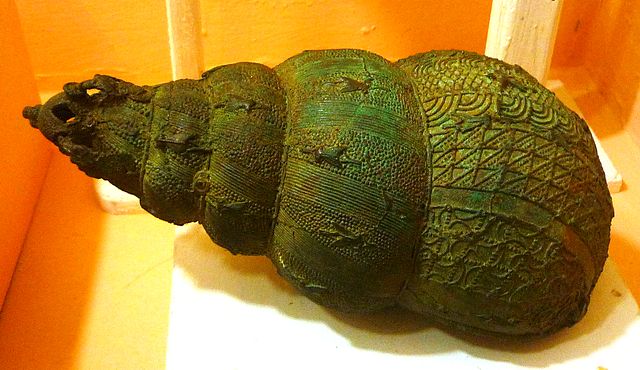
The Igbo-Ukwu archaeological site, a key remnant of the Nri civilization, provides powerful material evidence of its economic and artistic sophistication. The site, discovered by chance in 1938, contained hundreds of intricate bronze artifacts and over 165,000 glass beads, revealing an advanced and wealthy society.
The craftsmanship of the bronze objects is particularly remarkable. Items such as the “Vase with Rope” and “Shell Vessel with Leopard” demonstrate a technical mastery of the cire perdue (lost-wax) casting technique that was “notably more advanced than European bronze casting of this period”. Early academic speculation, often rooted in colonial-era prejudice, suggested these advanced artifacts must have been created after European contact. However, scientific analysis and radiocarbon dating have definitively refuted this, establishing a 9th-century date for the bronzes and confirming that the metal was of local origin.
The discovery of the glass and carnelian beads is equally significant. Research indicates that while some beads were of local West African origin, others were likely imported from as far as Egypt or even India, suggesting that the Igbo-Ukwu people were participants in the vast trans-Saharan trade networks. This archaeological evidence provides a powerful counter-narrative to colonial historiography, affirming the antiquity, wealth, and global connectivity of the Nri civilization long before European arrival.
| Artifact | Significance |
| Intricate Bronzes | Demonstrates advanced technological skill (lost-wax casting) and an established art tradition, showing a level of craftsmanship that was superior to contemporary European work. |
| Glass & Carnelian Beads | Evidence of long-distance trade networks, with beads traced to Egypt and India, debunking any notion of Nri as an isolated polity. |
| Ivory & Elephant Tusks | Indicates wealth and participation in the lucrative trade of luxury goods. |
| Preserved Textiles | Provides insight into the earliest known local textile technology, which vanished during the British colonial project in Nigeria. |
6. The Decline and Final Stand Against Colonialism
External Pressures and the Erosion of Influence
The zenith of Nri’s influence appears to have occurred between the 12th and 15th centuries. The kingdom began to decline after the start of the 18th century, a period of growing external pressures. The rise of militaristic neighboring states like the Benin and Igala kingdoms encroached on Nri’s sphere of influence. More critically, the Atlantic slave trade introduced a new economic reality. The lucrative opportunities presented by the slave trade, fueled by conflicts in the hinterland, began to erode Nri’s religious pacifism and moral authority. The kingdom’s greatest strength—its aversion to violence—became a vulnerability in a global context where military force and economic opportunism were dominant forces.
The Colonial Encounter and Passive Resistance
The final chapter of the kingdom’s political existence was marked by the British colonial encounter. The British, with their centralized, bureaucratic, and militaristic model of governance, were fundamentally incompatible with Nri’s decentralized theocratic system. While other African polities met the British with armed resistance, the Nri people’s opposition was largely passive, a continuation of their core philosophy. They relied on political diplomacy, religious symbolism, and the appeal to their spiritual leaders to oppose foreign domination, as a last stand.
The formal end of the Nri Kingdom as a political power came in 1911 when a British colonial expedition forced the reigning Eze Nri to renounce the ritual power of the ìkénga religion. This act effectively disbanded the traditional governance structures, imposing colonial rule. While the kingdom’s political authority was extinguished, remnants of the
eze hierarchy and its cultural influence persisted until the establishment of Colonial Nigeria.
7. Modern Legacy: Enduring Influence on Igbo Culture
Despite the formal political collapse in 1911, the legacy of the Nri Kingdom endures. Nri continues to be revered as the spiritual and cultural heartland of the Igbo people. Its influence is evident in the persistence of traditional Igbo customs and taboos, with its cultural norms permanently shaping the Northern and Western Igbo. Nri’s spiritual authority continues to be a source of cultural identity and heritage in contemporary Igbo society. The traditional religious practices, sacred symbols, and cultural beliefs associated with the kingdom remain influential in the lives of the Igbo people. A formal socio-cultural revival of the kingdom, beginning in 1974, further attests to its enduring relevance and its role as a source of pride and inspiration for the Igbo.
8. Conclusion: The Nri Kingdom as a Historical Anomaly
The Igbo Kingdom of Nri represents a profound historical anomaly. It was a civilization founded on a divine myth and governed by a non-military, spiritual authority that prioritized peace and moral purity above all else. Its power and influence were projected not through a standing army but through a sophisticated, decentralized system of ritual specialists and a nobility based on moral authority. The archaeological discoveries at Igbo-Ukwu serve as irrefutable material proof of this civilization’s antiquity, its advanced artistic and technological prowess, and its deep integration into wide-ranging international trade networks.
Ultimately, the decline and political end of the Nri Kingdom were not a failure of its internal logic but an inability to withstand a new global order that operated entirely outside of its moral and philosophical framework. In a world increasingly defined by the military and economic imperatives of the Atlantic slave trade and European colonialism, Nri’s pacifist, spiritual model of power became a vulnerability. The kingdom’s final act of resistance was a testament to its enduring principles, relying on diplomacy and spiritual authority even in the face of insurmountable military force. Nri’s unique history offers a powerful alternative to conventional narratives of state-building, demonstrating that profound and lasting influence can be achieved through moral authority and cultural ingenuity rather than through the force of arms.










Related Posts

Stay Informed With the Latest & Most Important News


Advertisement