Now Reading: Tola Wewe: The Painter of Spirits and Symbols
-
01
Tola Wewe: The Painter of Spirits and Symbols
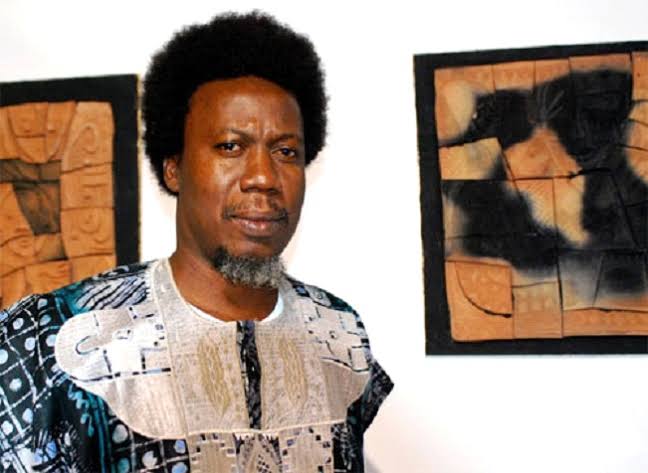

Early Life and Background
Tola Wewe was born in 1959 in Ondo State, Nigeria, into a Yoruba community where myth, ritual, and oral tradition strongly influenced daily life.
He studied Fine Arts at the University of Ife (now Obafemi Awolowo University) and later earned a Master’s degree in African Visual Arts from the University of Ibadan.
Artistic Career
Founding Member of Onaism
In the late 1980s and 1990s, Tola Wewe became one of the founding members of the Ona Artists’ Movement, also known as Onaism, alongside artists like Moyo Okediji.
- Ona (meaning “design, decoration, pattern” in Yoruba) sought to blend Yoruba traditional motifs, proverbs, and signs with modern artistic expression.
- This philosophy positioned Wewe as a cultural modernist who anchored contemporary painting in Yoruba aesthetics.
Style and Themes
Wewe’s art is instantly recognizable for its:
- Stylized, elongated figures, often mask-like, evoking spirits or ancestors.
- Bright colors and bold patterns, rooted in Yoruba textile and decorative traditions.
- Symbolism drawn from Yoruba mythology, cosmology, and folklore.
- Exploration of identity, spirituality, and the human condition through African visual languages.
Notable Works and Exhibitions
- Exhibited widely in Nigeria, Europe, and North America, in solo and group shows.
- Paintings like “Ere” (Play), “The Storyteller,” “Masquerade Series,” and “Mother and Child” highlight his consistent dialogue between tradition and modernity.
- His works are held in private and public collections worldwide.
Beyond the Studio
- Served as Commissioner for Culture and Tourism in Ondo State, Nigeria (2009–2011).
- Through this role and his art practice, he worked to promote Nigeria’s cultural heritage and the creative industry.
Influence and Recognition
- Recognized as one of Nigeria’s leading contemporary painters.
- Pioneer of Onaism, which remains an influential movement in Nigerian art history.
- His works continue to inspire younger artists seeking to root their practice in African cultural identity while exploring global relevance.
Legacy
Tola Wewe has carved a reputation as a visual storyteller of Yoruba mythology, bridging ancestral traditions and contemporary aesthetics. His art speaks of spirits, masquerades, and myths, yet addresses universal human questions, making him a vital figure in African modern art.
Conclusion
Tola Wewe is not just a painter but a custodian of Yoruba symbols and spirituality, reimagined for modern times. As a founding member of Onaism, he helped shape a movement that continues to define Nigerian contemporary art. His colorful, symbolic figures stand as timeless bridges between past and present, myth and reality.










Related Posts

Stay Informed With the Latest & Most Important News
Previous Post
Next Post


Advertisement