Now Reading: The Historical Trajectory of the Nigerian State: From Pre-Colonial Diversity to the Challenges of a Modern Nation
-
01
The Historical Trajectory of the Nigerian State: From Pre-Colonial Diversity to the Challenges of a Modern Nation
The Historical Trajectory of the Nigerian State: From Pre-Colonial Diversity to the Challenges of a Modern Nation

The history of Nigeria is a complex and multifaceted narrative, a product of deep-rooted indigenous cultures and external forces that profoundly reshaped the region. This report details the transformation of a pre-colonial landscape of diverse, independent polities into a single, centralized state, and the subsequent struggle to forge a cohesive national identity. The central argument is that the intentional and unintentional legacies of British colonialism, particularly the economic-driven amalgamation of 1914 and the policy of “divide and rule,” created a deeply fragile state. This fragility was later exacerbated by the discovery of oil, which institutionalized corruption and resource conflict, leading to a recurring cycle of political instability and military intervention. The contemporary challenges faced by Nigeria are not new problems but are the direct, cumulative result of a historical trajectory that has left the modern state in a constant struggle to overcome the structural flaws inherited from its founding.
Part I: Pre-Colonial Foundations: A Tapestry of Civilizations and Kingdoms
Before the advent of European colonialism, the geographical area now known as Nigeria was not a single entity but a vibrant mosaic of independent chiefdoms, states, kingdoms, and empires. These polities, each with its own distinct historical, social, and cultural identity, developed sophisticated systems of governance, trade, and artistic expression over millennia. The richness and diversity of these civilizations would later become a foundational vulnerability, as the lack of a unified state would be exploited to create internal divisions.
Archaeological evidence from different parts of the country demonstrates that human settlement in the Nigerian region dates back to the Palaeolithic period, approximately 500,000–9000 BC. The presence of stone tools and skeletons at Iwo Eleru, near Akure in Ondo state, dated at 12,000 years, confirms the existence of a Stone Age population. These early inhabitants were primarily hunters and gatherers who developed rudimentary “Oldowan” type tools from stones and pebbles for survival.
One of the most significant early civilizations was the Nok culture, which flourished in what is now central Nigeria (Kaduna State) from around 1500 BCE to 1 BCE. The Nok are widely regarded as one of the earliest known civilizations in sub-Saharan Africa, notable for their advanced iron metallurgy and unique terracotta sculptures. The earliest of these large, three-dimensional figurative artworks, found in the village of Nok and other sites, may date back to 900 BCE and are believed to have been part of a complex funerary culture. The Nok people were agriculturalists who cultivated crops like pearl millet, a grain indigenous to the Sahel, which supports the theory that they may have migrated from the West African Sahel or Central Sahara. Their artistic tradition is thought to have influenced later West African cultures, including those of Ife and Igbo-Ukwu.
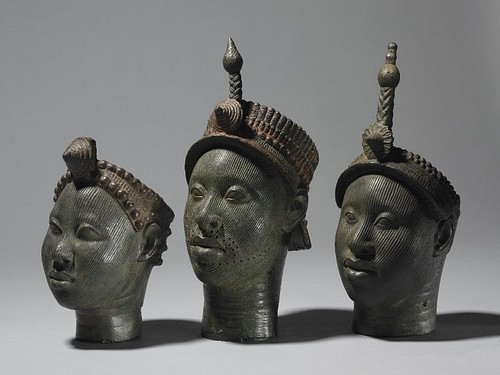
In the southern part of the region, highly centralized and artistically advanced kingdoms emerged. The Ife civilization is renowned for its naturalistic terracotta and bronze heads. Ife craftsmen also carved figures and stools from hard stone, such as quartz and granite. The Benin Empire, which existed from at least the 10th century and was ruled by a dynasty of kings known as the
Ogiso, was a powerful and centralized state. Its Oba, or king, was the highest political and religious authority, and the kingdom was famous for its sophisticated artistic guilds that produced intricate works in wood, ivory, and cast bronze and brass. At its peak, the military campaigns of the 15th and 16th centuries expanded the empire’s territory to include parts of modern-day Lagos and Ondo State.
Another major power in the southwest was the Oyo Empire, which was dominant among the Yoruba states from the 14th to 19th centuries. Founded by Oranmiyan, a son of the deity Oduduwa, the empire was known for its cavalry and a sophisticated system of government with a complex network of checks and balances. The power of the
Alaafin (ruler) was constrained by a group of leaders known as the Oyo Mesi, who in turn were under the scrutiny of the Ogboni society, a group of religious and political leaders. The collapse of the Old Oyo Empire gave birth to several of the modern Yoruba settlements that exist today.
In the North, the Hausa city-states (e.g., Daura, Kano, Katsina) were vibrant trading centers that flourished between the 14th and 19th centuries. They were characterized by a highly centralized, patriarchal political system, with a
Sarkin kasar acting as the chief executive and judge. These states were later replaced by the Sokoto Caliphate, a powerful Islamic empire that emerged from a series of religious campaigns led by the Fula people in the early 19th century. In stark contrast to these centralized northern kingdoms, the Igbo people of the East operated with a segmentary, decentralized political system. There was no single, highly centralized authority; instead, socio-political institutions like the family, council of elders, and age grades performed legislative, executive, and judicial functions within each village.
This profound diversity in governance and socio-economic organization meant that there was no single “Nigerian” identity or political culture before the 20th century. The historical trajectory of the region was not a linear progression of a single people but the parallel evolution of disparate polities. This lack of a unified, pre-existing state would become a critical vulnerability that an external power could leverage. The centralized polities would prove more conducive to external administration, while the decentralized ones would resist, setting the stage for future conflict.
Comparative Pre-Colonial Nigerian Polities
| Polity | Political Structure | Key Figures | Economic Basis | Geographic Location |
| Benin Empire | Centralized Monarchy | Oba | Bronze/Ivory Art, Wood Carving, Trade (including slave trade) | South-Eastern Nigeria (present-day Edo State) |
| Oyo Empire | Centralized Monarchy (with checks and balances) | Alaafin, Oyo Mesi, Ogboni | Cavalry-based military, Trade | Western Nigeria (present-day Oyo State and beyond) |
| Hausa Kingdoms / Sokoto Caliphate | Centralized Patriarchy, Caliphate | Sarkin kasar, Emirs | Trade in leather, gold, cloth, salt, animal hides | Northern Nigeria |
| Igbo Societies | Segmentary (Decentralized) | Council of Elders, Age Grades | Trade, Agriculture | South-Eastern Nigeria (present-day Anambra State) |
| Nok Culture | No clear social hierarchy evident | N/A | Agriculture (millet), Iron Metallurgy, Foraging | Central Nigeria (present-day Kaduna State) |
Part II: Colonialism’s Imposition: Amalgamation, Exploitation, and Division
The history of the Nigerian state is a product of colonialism, with the Europeans’ primary motivation being the extraction of natural resources. European contact with the peoples of the region began in the 15th century through trade and exploration along the coastal areas, with the Portuguese being the first to arrive. Early trade involved the exchange of European goods like mirrors and cloth for gold, pepper, and ivory. However, by the 16th century, this dynamic shifted, and the dominant trade became the Trans-Atlantic Slave Trade, which exported humans from the Nigerian geographical area to Europe and the Americas. The Benin Empire and the Aboh Kingdom were significant participants in this trade, controlling key marine trade routes in the Niger Delta and engaging with European powers like the Portuguese and British.
The “Scramble for Africa” formalized European imperial ambitions. The Berlin Conference of 1884-85 saw European powers arbitrarily divide the African continent, with the British targeting Nigeria for its abundant resources, including palm oil, tin, cotton, and cocoa. Through military conquest, the British suppressed native resistance and established control over the various pre-colonial states, incorporating them into the Lagos Colony and the Protectorate of Southern Nigeria by 1900. Nigeria’s immense value to the British Empire is underscored by the fact that it alone contributed 15 million subjects, a population greater than that of the entire German colonial empire.
The pivotal moment in the creation of the modern Nigerian state was the 1914 amalgamation. On January 1, 1914, Lord Frederick Lugard, the governor of both the Northern and Southern Protectorates, signed a document consolidating them into a single entity, the Colony and Protectorate of Nigeria. This union was undertaken for economic, rather than political, reasons. The Northern Nigeria Protectorate had a significant budget deficit, and the colonial administration sought to use the budget surpluses from the South, particularly customs revenues from Lagos, to offset the North’s financial liabilities. The amalgamation was, in effect, a financial solution to an administrative problem, creating a single, more economically viable entity for the British to exploit.
This union of convenience created a structurally flawed state. It disregarded the fundamental differences in political, social, and cultural organization that had existed for centuries. The British, under Lugard, established a centralized system of governance but implemented a policy of “indirect rule,” using traditional rulers as intermediaries between British authorities and the local population. This policy worked effectively in the North, where the British co-opted the existing hierarchical structure of the Sokoto Caliphate, turning Fulani emirs into salaried agents of the British administration. This system, however, was less effective in the South. While it was successfully applied in the Yoruba kingdoms with their centralized monarchies, it was met with frustration and resistance among the Igbo people, who had a decentralized, egalitarian system.
Beyond indirect rule, the British also employed a deliberate “divide and rule” policy to maintain control. They drew new borders that disregarded pre-existing linguistic and ethnic communities, and they fostered a system of “regionalism” that led to ethnopolitical and social conflicts. By promoting regional identity over a unified national identity and favoring certain groups over others, the British institutionalized ethnic rivalry. This ensured that political competition would be a zero-sum game based on ethnic and regional affiliation, rather than a contest of ideas for the national good. This is a foundational factor that would define Nigeria’s post-independence history.
Economic Drivers of Amalgamation
| Region | Economic Status | Primary Revenue Sources | Rationale for Amalgamation |
| Northern Protectorate | Budget Deficit | Indirect Taxes, Limited Trade | Required a financial subsidy to be viable and administratively manageable. |
| Southern Protectorate | Budget Surplus | Coastal Customs Revenues, Export Trade | Its surplus was needed to offset the Northern Protectorate’s deficit, creating a single, self-sufficient economic unit for the British. |
Part III: The Nationalist Struggle and the First Republic: A Fragile Dawn
The imposition of British colonial rule, with its exploitative and divisive policies, catalyzed a unified resistance. Nigerian nationalism, an ideology asserting that the disparate peoples of the colony should unite as one nation, emerged in the 1920s. This movement was spearheaded by figures who championed self-governance and criticized the injustices of the colonial administration.
Herbert Macaulay is widely regarded as the founder of Nigerian nationalism. An engineer and journalist, he became a vocal critic of the colonial government, arguing against policies like the exploitative water rate scheme. His activism and legal battles, such as the successful defense of the Eleko of Eko against the colonial government, cemented his reputation as a defender of indigenous rights. In 1923, he founded the Nigerian National Democratic Party (NNDP), the country’s first political party, which laid the groundwork for future nationalist movements. The nationalist cause was further strengthened by the return of World War II veterans and the actions of trade union leaders like Michael Imoudu, who organized a national general strike in 1945.
The independence movement was led by a trio of charismatic and influential figures, each with a distinct political philosophy and regional base.
- Nnamdi Azikiwe (1904–1996): Known as “Zik of Africa,” he was a major driving force behind independence and a pan-Africanist who advocated for a de-ethnicized, pan-Nigerian identity. He co-founded the National Council of Nigeria and the Cameroons (NCNC) in 1944, a party that aimed to represent various ethnic groups. Despite his vision of national unity, his political maneuvers, such as leaving the Western Region after a political defeat and returning to the East to gain power, inadvertently reinforced the regional and ethnic cleavages that already existed.
- Obafemi Awolowo (1909–1987): The first Premier of the Western Region and leader of the Action Group (AG). Awolowo’s political philosophy, which he termed “democratic socialism,” focused on social welfare and equitable development within a system of regional autonomy. He was a staunch advocate for public education and implemented a free primary education policy in the Western Region, laying the foundation for human capital development.
- Ahmadu Bello (1910–1966): As the leader of the Northern People’s Congress (NPC), he was the first Premier of Northern Nigeria. Bello was a “progressive conservative” who believed in retaining good traditions and customs while advocating for reforms. His primary focus was ensuring the North could compete politically and economically with the South. He chose to remain Premier of the North after the 1959 election, allowing his deputy, Abubakar Tafawa Balewa, to become the federal Prime Minister.
The journey to independence culminated on October 1, 1960, when Nigeria became a self-governing state, initially retaining the British monarch as a ceremonial head. The political system was based on a federal form of the Westminster model, with three semi-autonomous regions: North, West, and East. The 1959 federal election, which determined the country’s first government, was a clear reflection of the colonial legacy of regionalism. The NPC, NCNC, and AG each won a majority of seats in their respective regional strongholds, but no single party secured a national majority. The NPC and NCNC formed a coalition government, with the AG, led by Awolowo, becoming the opposition.
This political arrangement, while initially providing a fragile north-south consensus, was inherently unstable. The political philosophies of the leaders were fundamentally incompatible on a national scale. Azikiwe’s pan-Nigerian vision was undermined by his own regional politics, Awolowo’s regionalist approach was seen as a threat to national unity, and Bello’s focus on northern interests fueled a deep-seated fear of northern dominance in the South. The fragile balance was irrevocably disturbed in 1962 when a split in the AG led to a crisis in the Western Region. The federal government, led by the NPC-NCNC coalition, declared a state of emergency, effectively removing the AG from power. The subsequent conviction of Awolowo for treasonable felony further demonstrated the breakdown of democratic principles. This interference, combined with rigged elections in 1965, turned the Western Region into a “theater of war,” leading directly to the collapse of the First Republic on January 15, 1966.
Nigerian Nationalist Leaders and their Political Ideologies
| Leader | Political Party | Key Ideology | Regional Base |
| Nnamdi Azikiwe | National Council of Nigeria and the Cameroons (NCNC) | Pan-Nigerianism, Anti-colonialism | Predominantly Eastern, Pan-Nigerian rhetoric |
| Obafemi Awolowo | Action Group (AG) | Democratic Socialism, Regional Autonomy | Predominantly Western |
| Ahmadu Bello | Northern People’s Congress (NPC) | Progressive Conservatism, Northern Advancement | Predominantly Northern |
Part IV: From Civil War to a Cycle of Military Regimes (1966-1999)
The collapse of the First Republic initiated a period of chronic political instability. On January 15, 1966, a group of young army officers, led by Major Chukwuma Kaduna Nzeogwu and Major Emmanuel Ifeajuna, executed a coup d’état. They assassinated several prominent political leaders, including Prime Minister Abubakar Tafawa Balewa, Northern Premier Ahmadu Bello, and Western Premier Samuel Akintola. The coup leaders claimed their motivation was to eradicate corruption and mismanagement from the political system. However, the event was widely perceived, particularly in the North, as having an “ethnic colouration” because most of the assassinated leaders were from the North or West, while the coup plotters were predominantly Igbo from the East.
In the immediate aftermath, Major General Johnson Aguiyi-Ironsi, the most senior officer in the Nigerian Army and an Igbo, assumed control as the Head of the Federal Military Government. His attempt to unify the country by abolishing the federal system was met with deep suspicion, as Northern elites feared it was a move to establish Igbo superiority. Six months later, a counter-coup led by Northern officers overthrew and assassinated Aguiyi-Ironsi, installing Lieutenant Colonel Yakubu Gowon as head of state. This counter-coup sparked violent anti-Igbo pogroms in the North, with an estimated 2,000 Igbos killed.
Feeling unprotected by the federal government and facing persecution, the military governor of the Eastern Region, Lt. Colonel Odumegwu Ojukwu, declared the region’s secession as the Republic of Biafra on May 30, 1967. This declaration triggered the Nigerian Civil War, a conflict fueled by a combination of political, ethnic, and religious tensions that had preceded independence. A critical, and often unstated, cause of the war was the struggle for control over the lucrative oil production in the Niger Delta region. The war, which lasted from 1967 to 1970, was a devastating conflict. A Nigerian naval blockade led to a mass starvation of Biafran civilians, with an estimated 500,000 to 2 million people dying of hunger. The humanitarian crisis became one of the first wars to be televised globally, inspiring the creation of international non-governmental organizations like Doctors Without Borders. The war concluded with a Nigerian victory and the dissolution of Biafra. However, its legacy endured, leading to the political marginalization of the Igbo people and the rise of neo-Biafran secessionist movements that persist today.
The period from 1966 to 1999, with a brief democratic interlude from 1979 to 1983, was dominated by military rule. The military’s rise to power through a series of coups was consistently justified by the stated need to combat corruption and the failure of civilian governments to manage the state. The Nigerian state was governed by a succession of military heads of state, including Johnson Aguiyi-Ironsi, Yakubu Gowon, Murtala Mohammed, Olusegun Obasanjo, Muhammadu Buhari, Ibrahim Babangida, and Sani Abacha. The reliance on military intervention became a “seemingly permanent feature of Nigerian politics,” in part because the country’s deep ethnic and regional divisions meant there was no centralized opposition to military rule.
This period of military dominance was inextricably linked to the discovery and exploitation of oil. While oil was discovered in commercial quantities in 1956 at Oloibiri, Niger Delta, its full economic and political impact was realized after the Civil War. The military regimes progressively centralized control over oil revenues, with the federal government’s share increasing to 80% by 1975. This created a “rentier state” model, where political power was no longer about public service but about controlling access to the vast wealth from oil exports. This system led to endemic patronage and corruption, with a small elite siphoning off a massive portion of the oil wealth, leading to widespread poverty and underdevelopment for the general population.
This nexus between military power and oil wealth transformed the nature of Nigerian politics into a zero-sum game of resource control. The Niger Delta, the source of this wealth, became a site of conflict and environmental degradation. Local communities, feeling exploited and impoverished despite living on top of the nation’s primary revenue source, engaged in protests and violence, leading to a militarization of the region. The military-oil nexus ensured that successive regimes, despite their anti-corruption rhetoric, failed to deliver major reforms because the political system was founded on the very corruption they claimed to be fighting.
Military Heads of State and Defining Events (1966-1999)
| Name | Tenure (Dates) | Defining Event(s) | Reason for Intervention/Departure |
| Maj. Gen. Johnson Aguiyi-Ironsi | 1966 | Assumed power after 1966 coup, instituted a unitary system. | Overthrown and assassinated in 1966 counter-coup. |
| Gen. Yakubu Gowon | 1966–1975 | Led the country through the Nigerian Civil War. | Overthrown in a bloodless coup. |
| Gen. Murtala Mohammed | 1975–1976 | Initiated a transition program to civilian rule. | Assassinated in a coup attempt. |
| Gen. Olusegun Obasanjo | 1976–1979 | Completed the transition program, handing power to a civilian government. | Voluntarily handed power to a democratically elected government. |
| Maj. Gen. Muhammadu Buhari | 1983–1985 | Overthrew the Second Republic, citing corruption. | Overthrown by Ibrahim Babangida in a “palace coup.” |
| Gen. Ibrahim Babangida | 1985–1993 | Longest-serving peaceful military administration, annulled the 1993 election. | Resigned and handed power to an interim government. |
| Gen. Sani Abacha | 1993–1998 | Overthrew the interim government, led a repressive regime. | Died in office. |
| Gen. Abdulsalami Abubakar | 1998–1999 | Implemented a swift transition to democracy. | Voluntarily handed power to a democratically elected president. |
Part V: The Fourth Republic: Transition and Persistent Challenges
After decades of military rule and political turmoil, Nigeria embarked on a new journey toward democracy. On May 29, 1999, the military government, under the leadership of General Abdulsalami Abubakar, transferred power to a democratically elected president, Olusegun Obasanjo. Obasanjo, a former military head of state who had previously handed power to a civilian government in 1979, campaigned on a platform of combating corruption, strengthening public institutions, and fostering good governance. His inauguration marked the beginning of Nigeria’s Fourth Republic, a new era that Nigerians hoped would bring stability, peace, and prosperity.
Despite the return to civilian rule, many of the country’s most pressing challenges are not new but are a direct inheritance of the structural flaws and historical legacies detailed in this report. The persistent issues of insecurity, corruption, and ethnic-religious conflict are the cumulative result of a historical trajectory that began with the arbitrary colonial amalgamation, was exacerbated by the regionalist politics of the First Republic, and was cemented by the centralizing and corrupting influence of military rule and oil wealth.
One of the most significant challenges today is widespread insecurity. The nation is grappling with a myriad of security crises, including the Boko Haram insurgency, which seeks to establish an Islamic state in the North, as well as farmer-herder clashes and kidnapping for ransom. The Boko Haram group has killed over 40,000 people and displaced millions, extending its violence to neighboring countries. This insecurity is fueled by factors such as high unemployment, poverty, poor governance, and the exploitation of ethnic and religious divides by political elites.
Ethno-religious tensions, which were actively fostered by colonial policies, continue to be a source of violent conflict. Religious strife between Christians and Muslims can be traced as far back as 1953, and a major upsurge in violence occurred in the 1980s. The introduction of strict Sharia law in some northern states since the return to democracy in 1999 has heightened these tensions. These conflicts are often intertwined with competition for resources and political power, mirroring the dynamics established during the colonial and post-independence periods.
Finally, the struggle for good governance remains a central theme. The political economy of oil, which took hold during the military era, has left a legacy of endemic patronage and corruption that permeates all levels of government. A 2002 conference on Nigerian governance identified over-centralization, lack of transparency, lack of economic diversification, and corruption as critical problems. The Niger Delta, the source of the nation’s wealth, remains a site of environmental degradation, with thousands of oil spills recorded between 1976 and 2001, and a perpetual struggle between local communities and the state over resources.
The modern Nigerian state is in a constant struggle to overcome the historical legacies of its founding. The political system, initially conceived as a union of convenience, has failed to bridge the profound ethnic, religious, and political divides that were either inherited or created by colonial rule. The constant cycle of military intervention and the centralizing power of oil wealth have further weakened democratic institutions and the rule of law. The contemporary challenges are not new; they are the enduring symptoms of a structurally flawed foundation, and Nigeria’s history is a continuous narrative where the decisions and consequences of each period set the stage for the next.
Historical Roots of Contemporary Nigerian Challenges
| Contemporary Challenge | Historical Period of Origin | Specific Causal Factor |
| Insecurity | First Republic, Military Regimes | Regionalism, Ethnic tensions, and military intervention cycles. |
| Corruption | Colonial Era, Military Regimes | Economic-driven amalgamation and the subsequent centralization of oil wealth. |
| Ethnic/Religious Conflict | Colonial Era, Military Regimes | “Divide and rule” policies and the exploitation of religious and ethnic differences for political control. |
| Weak Governance | Colonial Era, First Republic, Military Regimes | The imposition of a centralized state on diverse polities and the breakdown of democratic institutions. |
| Economic Instability | Post-Independence Era | The reliance on a single commodity (oil) and the rentier state model. |










Related Posts


Stay Informed With the Latest & Most Important News
Previous Post
Next Post
Advertisement