Now Reading: Contemporary Nigerian Art: A Comprehensive Analysis of its History, Practice, and Market Ecosystem
-
01
Contemporary Nigerian Art: A Comprehensive Analysis of its History, Practice, and Market Ecosystem
Contemporary Nigerian Art: A Comprehensive Analysis of its History, Practice, and Market Ecosystem

I. Executive Summary
This report provides a comprehensive, expert-level analysis of contemporary Nigerian art, tracing its evolution from a post-colonial identity movement to a dynamic global market force. It synthesizes historical context, artistic practices, key themes, and market dynamics to offer a definitive resource for professionals, collectors, and researchers. The analysis reveals that contemporary Nigerian art is defined by an ongoing, ideological “natural synthesis” of indigenous traditions and Western influences. The market is increasingly bifurcated, with high-value modernist works driving top auction prices while “ultra-contemporary” figurative art captures the attention of a younger, digitally savvy collector base. The robust growth observed is not merely a market phenomenon but is deeply intertwined with a broader cultural renaissance spanning literature, film, and music, which collectively amplify the nation’s global cultural footprint.
II. The Historical and Conceptual Foundations of Contemporary Nigerian Art
The Genesis: From Function to Expression
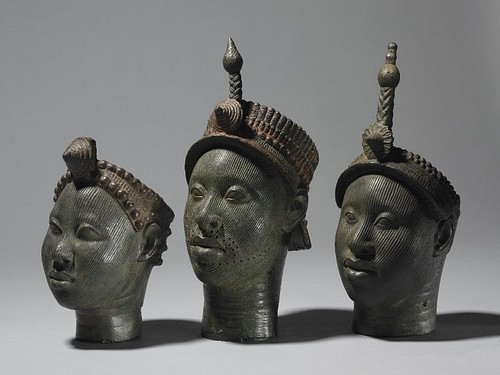
Before colonial rule, art in Nigeria was profoundly functional and spiritual, serving religious, social, and political purposes. Examples such as the Igbo Uli body and wall paintings were used to mark significant life passages, while the bronze and brass sculptures from the Kingdom of Benin depicted a king’s military achievements and court rituals. This traditional art was often created anonymously and was deeply integrated into the fabric of daily and spiritual life.
The colonial era introduced a profound shift. The British established formal art education with institutions such as the Nigerian College of Arts, Science and Technology in Zaria (NCAST – now Ahmadu Bello University). This exposed Nigerian artists to Western techniques, including drawing and painting, and European art movements like Impressionism and Cubism. However, this period also saw the suppression of traditional art forms, which were often deemed inferior by colonial authorities, leading to a decline in practices like Uliism. This tension between cultural suppression and exposure to new ideas set the stage for a creative rebellion in the mid-20th century, as artists began to actively merge Nigerian traditions with Western contemporary practices, both to resist colonial impositions and to celebrate their cultural heritage.
Pioneering Post-Colonial Art Movements
The emergence of contemporary Nigerian art in the 1960s, following Nigeria’s independence, was marked by a vibrant “cultural explosion” and a “flowering of artistic expression”. This was not a passive adoption of Western styles but an active pursuit of a new visual language that reflected the country’s unique cultural and political identity. The foundational ideologies of this period continue to shape the field today, as they represent the first deliberate efforts to navigate the relationship between indigenous traditions and global influences. The debate over whether globalization leads to artistic homogenization or facilitates the exchange of ideas is a direct continuation of this foundational struggle, which began with the Zaria Art Society’s ideological framework.
Table 1: Key Post-Colonial Art Movements in Nigeria
| Movement Name | Year Founded | Primary Location | Key Ideology | Notable Founding Artists |
| Zarianism | 1958 | Zaria | “Natural Synthesis”: a fusion of indigenous traditions with Western art techniques. | Uche Okeke, Bruce Onobrakpeya, Demas Nwoko |
| Ulism | 1961 | Nsukka | Revival of the traditional Igbo Uli aesthetic. | Uche Okeke (influenced) |
| Osogbo Art | 1962 | Osogbo | Experimental, spontaneous, and non-academic approach drawing from Yoruba mythology. | Susanne Wenger, Twins Seven Seven, Nike Okundaye |
| Onaism | 1989 | Ife | Emphasis on indigenous motifs and forms for contemporary expression. | Abiodun Akande |
| Araism | 2006 | Lagos | A form of contemporary art founded by Mufu Onifade. | Mufu Onifade |
Export to Sheets
The Zaria Art Society, established on October 9, 1958, was the country’s first serious art movement. Founded at NCAST, its core ideology was a “natural synthesis,” which advocated for the deliberate and harmonious fusion of indigenous Nigerian traditions with Western artistic techniques. This was a radical act of cultural decolonization, a rebellion against the colonial-imposed “superiority” of European art forms. The movement’s members, including pioneering artists like Bruce Onobrakpeya and Demas Nwoko, sought to establish an authentic and progressive visual language that was distinctly Nigerian.
Other significant movements that emerged in the wake of Zarianism include the Nsukka School (Ulism) in 1961, which focused on reviving the traditional Igbo Uli aesthetic, once suppressed by colonial rule. The
Osogbo Art School, founded in 1962, was known for its experimental and spontaneous approach. These early groups, which also included the later movements of
Onaism and Araism, largely shaped what is considered Nigerian contemporary art today. The foundational struggle of these movements, which sought to define a new cultural identity through a fusion of the old and new, highlights that the contemporary tension between local and global influences is deeply rooted in the very genesis of the art form. This reveals that a singular focus on painting or sculpture would be inaccurate, and the interdisciplinary nature of the art form is a core, historical characteristic, as groups like the Zaria Art Society fused diverse techniques and traditions to create “vibrant, multidimensional works” that included painting, sculpture, and poetry.
III. Artistic Expression: Themes, Techniques, and Media
A Thematic Nexus
Contemporary Nigerian art serves as a powerful vehicle for social and political commentary, with artists engaging with a wide range of issues that resonate on both local and global scales. Recurring themes include the navigation of hybrid identity, the legacy of colonialism, and social justice. Artists often explore the complexities of occupying two cultural worlds—Nigerian and American, for example—as seen in the work of Njideka Akunyili Crosby, who describes her practice as negotiating the “cultural terrain” between her adopted home and her native Nigeria. The work of Peju Alatise exemplifies the focus on social justice, particularly addressing issues of gender inequality and child labor, using her art as a powerful “means of raising awareness and denouncing social injustices”.
The Dominance of Figuration
A defining trend in the contemporary market is the prevalence and significance of figurative art, particularly what is now known as “Black Figuration”. This art style focuses on “Black self-representation by artists from Africa and its diaspora who are imagining, positioning, memorialising and asserting African and African-descent experiences”. The popularity of this style is evident in the work of artists such as Arinze Stanley, who creates hyperrealist pencil drawings that are often mistaken for photographs, and Àsìkò, who creates emotionally-charged photographic portraits that express culture through aesthetics. This stylistic choice serves as a powerful vehicle for storytelling, cultural assertion, and reclaiming narratives.
Beyond the Canvas: A Material and Technical Revolution
The transition from traditional, locally-sourced materials to a wide range of innovative media is a hallmark of contemporary Nigerian art. While traditional art often relied on materials like wood and clay for functional purposes, contemporary artists are experimenting with modern materials, including metal, glass, and mixed media.
The choice of medium is often a thematic statement in itself, not merely a technical preference. The use of discarded materials, for example, is a prevalent technique that serves as a direct commentary on contemporary issues. Victor Ehikhamenor’s “Broken English” series incorporates old cans and bottles to highlight the ways in which Nigerian society is marked by consumption and waste. Similarly, the renowned artist El Anatsui is known for his large-scale sculptures made from recycled materials, which are not only visually striking but also serve to address environmental concerns. This demonstrates how the
how of artistic creation is used to amplify the what of the message, demonstrating a deep connection between the medium and the social commentary.
Another significant development is the emergence of digital art. The arrival of personal computers and digital photography in the latter half of the twentieth century sparked a new wave of creativity among Nigerian artists. This medium is not just a modern tool but is used as a “medium of postcolonial resistance” , challenging the prevailing narrative that digital practices are solely a Western phenomenon. Dennis Osadebe, for example, combines digital tools with mixed-media painting to create his “neo-visual” style, using the helmet as a recurrent motif to symbolize protection and isolation in the face of modernity.
Furthermore, the work of artists like Njideka Akunyili Crosby demonstrates how the supposed conflict between local and global influences can lead to a uniquely “transcultural, syncretic space”. Her mixed-media work is a deliberate fusion of Nigerian and American cultures, utilizing techniques like acetone-transfer prints. The visual sharpness lost in this process is a conscious, symbolic choice by the artist, as it represents how information can be lost as people move between cultural spaces. This powerful articulation shows that global influence, when channeled through an artist’s personal experience, can result in a new and authentic form of expression that is a direct counterpoint to the fear of artistic homogenization.
IV. A Pantheon of Influential Artists: Case Studies in Nuance
The contemporary Nigerian art scene is defined by a diverse group of influential artists whose work has resonated both locally and internationally. These figures, from the pioneers of modernism to the new wave of global practitioners, collectively showcase the breadth and depth of the art form.
Table 2: Profiles of Influential Contemporary Nigerian Artists
| Artist Name | Primary Mediums | Core Thematic Concerns | Notable Works |
| Ben Enwonwu | Painting, Sculpture | Bridging indigenous and Western aesthetics, cultural identity, Negritude philosophy. | “Tutu,” “Yoruba Woman in Blue” |
| Yinka Shonibare CBE | Mixed-media installation, Sculpture, Photography, Film | Colonial legacy, race, class, cultural identity. | “Un Ballo in Maschera,” “The Swing (after Fragonard)” |
| Njideka Akunyili Crosby | Mixed-media, Collage, Photo Transfer | Diasporic identity, cultural hybridity, female agency. | “The Rest of Her Remains,” “The Beautyful Ones” series |
| Victor Ehikhamenor | Mixed-media, Sculpture, Installation | Postcolonial politics, dualities of cultural realities, environmental commentary. | “Broken English” series |
| Peju Alatise | Painting, Sculpture, Installation, Writing | Social justice, gender inequality, child labor, Yoruba mythology. | “Flying Girls” |
Export to Sheets
Ben Enwonwu (1917–1994): The Father of Nigerian Modernism
Ben Enwonwu is widely considered a foundational figure of Nigerian modernism, a bridge between traditional art and global modernism. With his Western art training, Enwonwu became a teacher and a crucial voice in the post-independence era. His works, which he labeled as characteristically indigenous Impressionism, consciously discouraged the simplistic labeling of African art. He articulated his philosophy by stating that “art is not static, like culture,” and that it “continues to evolve through change and adaptation to new circumstances”. His most famous works, such as “Tutu,” a portrait of Nigerian princess Adetutu Ademiluyi, and “Yoruba Woman in Blue,” have consistently achieved world record prices at auction, demonstrating his enduring legacy and market power. The high auction value of Enwonwu’s works indicates that the foundational phase of the movement is considered a valuable historical asset by the global art market, providing a stable backbone to the more volatile “ultra-contemporary” sector.
Yinka Shonibare CBE (b. 1962): Deconstructing the Colonial Legacy
British-born Nigerian artist Yinka Shonibare is internationally renowned for his work across diverse artistic media, including painting, sculpture, and film. His core themes revolve around exploring ideas of African contemporary identity and the enduring legacy of European colonialism. His signature use of “Dutch wax” fabric is central to this critique. Although widely associated with African culture, the fabric was inspired by Indonesian batiks and produced in Europe for the West African market, symbolizing for Shonibare the complex web of economic and racial interdependencies between Europe, Asia, and Africa. By clothing headless mannequins in elaborate costumes made from this fabric, he satirizes and challenges notions of race, class, and cultural identity. The artist’s decision to adopt the honorific “CBE” (Commander of the Order of the British Empire) into his name is a deliberate act, a “platform” from which to critique the very establishment that bestowed the title upon him.
Njideka Akunyili Crosby (b. 1983): Layered Narratives of the Diaspora
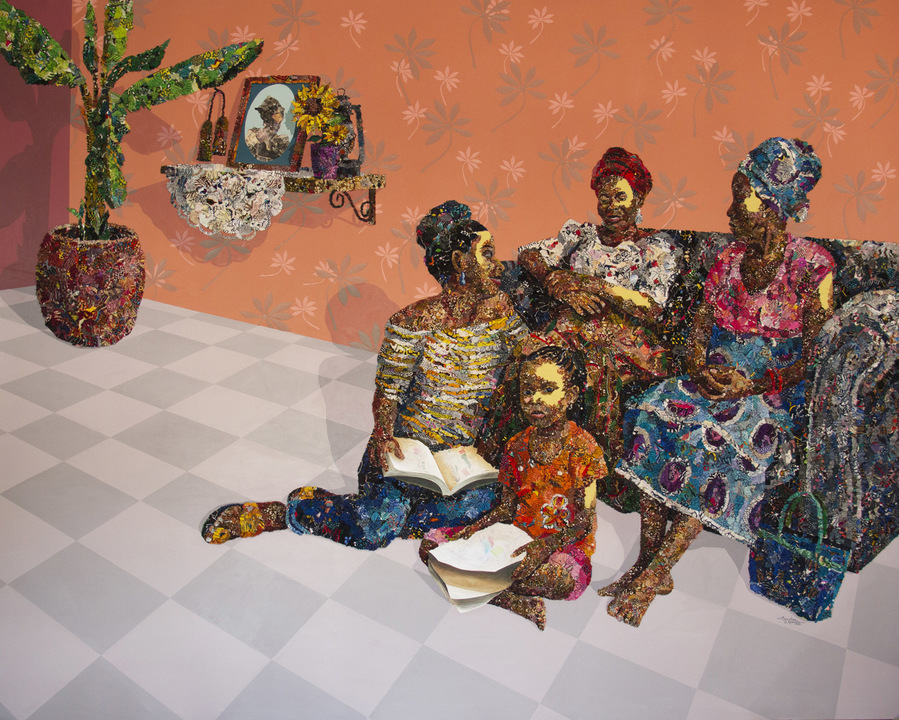
Njideka Akunyili Crosby’s work provides a compelling visual narrative of diasporic identity. Through her meticulously layered compositions, she combines painted figures with photographic transfers derived from her personal image archive and popular Nigerian magazines. This practice allows her to “negotiate the cultural terrain between her adopted home in America and her native Nigeria”. A particularly powerful aspect of her work is the use of acetone-transfer prints, a technique that deliberately reduces the visual sharpness of a photograph. The artist has noted that she enjoys this effect because it “seems symbolic of how information is lost as people move between cultural spaces”. This profound connection between a technical process and a lived experience elevates her work beyond simple figuration, making it a powerful commentary on the intricacies of hybrid identity. Her art, which also emphasizes female agency, is a prime example of the “Black Figuration” trend that is currently driving significant market demand.
Victor Ehikhamenor (b. 1970): The Interplay of Tradition and Commentary
Victor Ehikhamenor is a Nigerian-American multidisciplinary visual artist and writer whose work is deeply inspired by his upbringing in the aesthetic and spiritual traditions of the Edo people. His art features gestural abstraction and stylized forms that incorporate complex, illegible ancient scripts and symbols from Edo religion and Catholicism. His work serves as a form of social commentary, drawing on traditional Nigerian art forms to challenge prevailing ideas about African art. His “Broken English” series, for example, uses discarded materials like old cans and bottles to highlight the issues of “consumption and waste” in Nigerian society, demonstrating how the use of found objects can be both a technical choice and a profound statement on contemporary life.
Peju Alatise (b. 1975): A Poetic Expression of Social Justice
An interdisciplinary artist, poet, and writer, Peju Alatise is a major figure in the contemporary African art scene. Her work focuses primarily on women in Nigeria, as well as the political and religious issues shaping the country. She uses a variety of media, including painting, sculpture, and writing, to address important social and political themes, often incorporating elements of Yoruba literature and mythology. Her most notable work, “Flying Girls,” which was presented at the 2017 Venice Biennale, exemplifies her commitment to social justice. This installation features eight life-size girls with wings, embodying the dream of a young cleaner yearning for freedom from child labor. The work offers a poignant and imaginative vision for a better future, raising crucial questions about gender inequality and female emancipation.
V. The Ecosystem of the Nigerian Art Market
The Nigerian art market is a dynamic and evolving ecosystem, supported by a growing network of galleries, museums, and international platforms. The market’s growth is driven by both established, high-value modernist works and the rising demand for ultra-contemporary art, reflecting a diverse and expanding collector base.
Market Dynamics and Trends
The global art market has seen significant shifts, with “ultra-contemporary” art pieces by African-born artists accounting for the highest sales volume in the market. This surge can be attributed to the much lower price point of these works and their appeal to a younger generation of art collectors who are more comfortable with online purchases. Movements such as Black Lives Matter and the curatorial efforts of influential figures like Okwui Enwezor have played a crucial role in expanding the Western art canon to include artists from Africa and the Global South, driving collectors to diversify their portfolios. The forecast for the global art market suggests continued growth, which presents a significant opportunity for African art to solidify its position as a viable sector within the broader creative economy.
A powerful force driving this momentum is the broader Nigerian cultural renaissance. The global success of Nigerian literature, music, and film creates a synergistic effect, drawing attention and investment into the visual arts. This suggests a symbiotic relationship where success in one cultural sphere can amplify interest in others, creating a positive feedback loop of sustained global engagement.
Auction Performance: The Blue-Chip Market
While ultra-contemporary art drives volume, the blue-chip market for modernist works demonstrates the high-value potential and historical significance of Nigerian art. Major auction houses like Bonhams and Sotheby’s have consistently achieved record-breaking sales for works by Nigerian masters.
Table 3: Significant Auction Sales of Nigerian Art (2018-2023)
| Artist | Artwork Title | Year of Sale | Auction House | Sale Price (approx.) |
| Ben Enwonwu | Tutu | 2018 | Bonhams | $1.7 million |
| Ben Enwonwu | Yoruba Woman in Blue | 2023 | Bonhams | £686,200 |
| Yusuf Grillo | The Seventh Knot | 2023 | Bonhams | £403,500 |
| Ben Enwonwu | Christine | 2018 | Sotheby’s | $1.4 million |
| Demas Nwoko | Children on Cycles | N/A | Bonhams | $225,075 |
Export to Sheets
The sale of Ben Enwonwu’s Tutu for a record-breaking $1.7 million in 2018 and his painting Christine for $1.4 million at a Sotheby’s auction underscores the immense financial value and historical importance of Nigerian modernist works. The auction results for artists like Yusuf Grillo and Demas Nwoko, with works selling for hundreds of thousands of pounds and dollars, further validate the market’s maturity. This strong performance of modernist masters provides a stable foundation for the entire market, legitimizing it for both seasoned and new collectors.
Galleries, Museums, and Platforms
The art ecosystem in Nigeria, particularly in Lagos, has a robust and diverse infrastructure that is becoming increasingly professional and self-sustaining. This network plays a crucial role in promoting artists, educating the public, and building a sustainable art market.
Table 4: Major Galleries and Museums in the Nigerian Art Ecosystem
| Institution Name | Location | Primary Focus |
| Omenka Gallery | Lagos | Modernist and Contemporary Nigerian art; advisory services, publications. |
| Nike Art Gallery | Lagos | Traditional African art and craft, textile museum. |
| African Artists Foundation (AAF) | Lagos | Emerging artists and contemporary art; provides a creative platform. |
| Yemisi Shyllon Museum of Art (YSMA) | Lagos | Private collection of modern Nigerian art; educational resource. |
| Rele Gallery | Lagos, London, Los Angeles | Contemporary artists from the African diaspora; operates a “Young Contemporaries” program. |
| National Commission for Museums and Monuments (NCMM) | Abuja, multiple locations | Preserving, promoting, and developing Nigeria’s cultural heritage. |
Export to Sheets
Key local institutions, such as the Omenka Gallery, founded by the son of Ben Enwonwu, represent a fine selection of established and emerging artists and offer a range of advisory services, from appraisals to collections management. Omenka’s robust publications program and scholarly texts help stimulate critical discourse on contemporary art, a sign of a maturing art ecosystem. The
Nike Art Gallery, one of West Africa’s largest art repositories, serves as a comprehensive collection of traditional African art and crafts, helping to preserve cultural heritage. The
African Artists Foundation (AAF) and Art Twenty One in Lagos are dedicated to championing emerging artists and contemporary art.
The art ecosystem’s global reach is exemplified by Rele Gallery, which has locations in Lagos, London, and Los Angeles. Rele’s focus on artists from the African diaspora and its “Young Contemporaries” program demonstrate a concerted effort to build a professional, curatorial, and educational infrastructure from within Nigeria. On a national level, the
National Commission for Museums and Monuments (NCMM) plays a vital role in preserving Nigeria’s cultural heritage through exhibitions, research, and the digitization of collections. This shows that the market’s growth is not just a commercial trend but is part of a broader, more profound effort to create a self-sustaining artistic and cultural ecosystem.
VI. Conclusion and Future Outlook
Synthesized Insights
Contemporary Nigerian art is a testament to the country’s resilience and dynamism. Its evolution from a post-colonial identity project to a multifaceted global force is a direct result of artists’ ability to synthesize local narratives with universal themes and leverage new mediums. The historical tension between tradition and modernity, once a source of artistic rebellion, has evolved into a creative engine for innovation. The art market, while exhibiting moments of volatility, shows a promising future, driven by a new generation of artists and collectors who are redefining the value and perception of African art on a global scale. The high prices commanded by modernist masters provide a stable foundation, while the burgeoning ultra-contemporary market captures the attention of a younger, more diverse audience, creating a dynamic and bifurcated ecosystem.
Challenges and Opportunities
The primary challenge for contemporary Nigerian art is the ongoing negotiation of a unique artistic voice in the face of rapid globalization. Critics have raised concerns that globalization could lead to a homogenization of styles, with Nigerian artists simply mimicking global trends. However, the evidence suggests a counter-narrative, where artists are actively using global influences to create a new, hybrid form of expression.
The opportunities for future growth are substantial. The fastest-growing millionaire population on the continent could lead to a significant increase in local art collectors, reducing the market’s reliance on external demand. The continued use of digital platforms presents a unique opportunity for artists to connect with a global audience without traditional intermediaries. Furthermore, the maturation of local institutions, from galleries to museums and art residency programs, will create a more professional and self-sustaining ecosystem that can nurture and promote talent from within.
Strategic Recommendations
Based on this comprehensive analysis, the following strategic recommendations are provided for various stakeholders:
- For Collectors: A balanced portfolio is advisable. The modernist masters, such as Ben Enwonwu and Yusuf Grillo, represent stable, long-term investments due to their historical significance and consistent auction performance. Simultaneously, engaging with emerging ultra-contemporary artists offers the potential for high-growth appreciation and cultural relevance.
- For Institutions: Deepen partnerships with local Nigerian galleries and art spaces to establish a direct link to emerging talent and support the burgeoning ecosystem. Investing in and promoting the work of contemporary female artists, who have demonstrated strong market performance, is a particularly strategic avenue for collection diversification.
- For Artists: The most compelling work is often that which is rooted in local cultural heritage while engaging with universal themes. Continuing to experiment with new technologies and recycled materials as a vehicle for nuanced commentary will be crucial for artistic innovation. Leveraging digital platforms is essential for direct engagement with a global audience and fostering a community of collectors.










Related Posts


Stay Informed With the Latest & Most Important News

Advertisement