Now Reading: A Comprehensive Analysis of the Traditional Yoruba Wedding as a Cultural Rite of Passage
-
01
A Comprehensive Analysis of the Traditional Yoruba Wedding as a Cultural Rite of Passage
A Comprehensive Analysis of the Traditional Yoruba Wedding as a Cultural Rite of Passage

The traditional Yoruba wedding in Nigeria, known as Igbeyawo, is far more than a simple celebration of two people coming together. It is a highly structured, multi-stage cultural institution that serves as a profound rite of passage. This report provides an in-depth analysis of the Yoruba matrimonial process, from its foundational principles to its modern adaptations. It examines the intricate layers of negotiation, ritual, and symbolic expression that define this grand affair. By applying an anthropological framework, the report reframes the ceremony not merely as a festive event but as a meticulously choreographed ritual of social transformation. At its core, the Yoruba wedding affirms the union of two families, not just two individuals, and meticulously guides the bride through a structured transition from her old identity to her new status as a married woman within her husband’s lineage. The analysis concludes that while modern forces have influenced certain aspects, the core values of community, respect, and humility remain at the heart of this vibrant and enduring tradition.
Introduction: The Foundational Pillars of Yoruba Matrimony
The traditional Yoruba wedding is a deeply significant and elaborate event that showcases the rich cultural heritage of the Yoruba people of Southwestern Nigeria. It is an occasion that transcends the union of a man and a woman to become a formal alliance between two extended families. This foundational principle of communal bonding is the ideological bedrock upon which all subsequent rituals and customs are built. The ceremony’s emphasis on collective responsibility and support highlights a core Yoruba value system where family unity and respect are paramount.
To fully comprehend the depth and purpose of these rituals, it is useful to view the Yoruba wedding through the lens of Arnold van Gennep’s three-phase rite of passage theory: pre-liminal, liminal, and post-liminal. This academic framework provides a robust structure for understanding the entire process, revealing a deeper, structural logic behind the seemingly disparate rituals. The various stages of the ceremony are not random customs but deliberate “semiotic markers” and “transitional vehicles” designed to facilitate a profound social and physiological change, particularly for the bride. The process begins with her symbolic detachment from her old status, moves through a period of transition, and culminates in her full incorporation into her new identity and family. The entire process, from the initial courtship to her final entry into her new home, is a carefully orchestrated journey that solidifies the transition from one social structure to another, ensuring the continuity of cultural values.
The Pre-Liminal Stage: The Path to Formal Union
The Initial Inquiry and Introduction Ceremony
The path to matrimony begins with a process of courtship and formal inquiry, marking the pre-liminal or separation phase of the rite of passage. The first formal step involves the groom seeking an intermediary, known as the
Alarina, to approach the bride’s family on his behalf. This intermediary, who may be a friend, sibling, or elder, serves as a crucial cultural gatekeeper, informing the bride of the groom’s intentions and, with her approval, conveying the message to her parents. The parents then consult their daughter to confirm her feelings for the suitor.
Once intentions are formally acknowledged, the two families schedule a meeting for the Introduction Ceremony. Historically, this was a small, intimate gathering held at the bride’s family home, bringing together nuclear and extended family members for the first time. The purpose was for the families to get to know each other, exchange formal greetings and gifts, and discuss the terms of the marriage, including setting a date for the main engagement ceremony. Over time, however, a notable evolution has transformed this once-private event. In modern times, the introduction ceremony has increasingly become a more public and elaborate affair, often described as a “mini traditional wedding” where the couple and their families wear beautiful matching outfits. This amplification of a simple family gathering reflects a broader cultural shift, moving the focus from intimate negotiation to a more public display of social standing and affluence, a trend that is a precursor to the grand spectacle of the main ceremony. The transition of this ritual from a simple meeting to a celebratory spectacle demonstrates how modernization and urbanization have influenced the ceremonial structure, with the effect of commercializing and expanding the event.
The Bride Price and Eru Iyawo
Following the introduction, the groom’s family receives a comprehensive list of gifts, known as the Eru Iyawo, from the bride’s family. This list, which is often finalized through discussions between the families, is a central and non-negotiable part of the process. The
Eru Iyawo is distinct from the symbolic bride price, which is often a nominal monetary amount, and its presentation is not a transaction but a deeply meaningful gesture. It is a show of appreciation for the parents’ efforts in raising their daughter and an acknowledgment of the sacrifices made in her upbringing and education. The meticulous packaging of these gifts in decorative baskets or boxes, often accompanied by music and dancing, underscores the respect and goodwill the groom’s family has for the bride’s family.
The list of gifts for the Eru Iyawo is laden with cultural symbolism, as each item carries a specific blessing and hope for the couple’s future. The fulfillment of this list is a public demonstration of the groom’s commitment to providing for his bride and a formal recognition of the sacred bond being formed between the two families.
Item on Eru Iyawo List | Symbolic Meaning |
Honey, Sugarcane, Sugar (Oyin) | Signifies a sweet, harmonious marriage that will never be sour. |
Salt (Iyo) | Represents tastiness and a life with flavor, ensuring their union is never bland. |
Kola Nuts (Obi) and Bitter Kola (Orogbo) | Symbolizes longevity, prosperity, and the waving away of sickness and diseases. |
Alligator Pepper (Atare) | A symbol of fruitfulness and abundance for the couple. |
Fish Head (Eja Abori) | The couple will always overcome their enemies, as the head of a fish is never turned back. |
| Bible or Qur’an | A foundational symbol of faith, representing a marriage rooted in divine blessing and spiritual guidance. |
| Tubers of Yam | Signifies a commitment to a life of abundance and provision. |
Traveling Bag (Bembe) | A box given by the bride’s mother for her to keep her belongings, symbolizing her journey to a new home. |
Beads (Iyun & Segi) | Represents royalty and wealth. |
The Liminal Stage: The Grand Ceremony of Transition
The Maestros of Ceremonies: Alaga Iduro and Alaga Ijoko
The traditional engagement ceremony marks the liminal phase, the “threshold zone” where the bride is suspended between her old and new social identities. This grand event is orchestrated by two female MCs, who serve as the official representatives and cultural custodians for each family: the
Alaga Iduro (the standing MC) for the groom’s side and the Alaga Ijoko (the sitting MC) for the bride’s side. Their vibrant, witty, and often musical dialogue is a central element of the ceremony, ensuring adherence to tradition while also providing lively entertainment.
The relationship between the Alaga Ijoko and Alaga Iduro is a formalized, performative reenactment of the historical family negotiation. The Alaga Ijoko acts as the gatekeeper, playfully challenging the groom’s family, and even levying small fees, such as a toll fare for entry or a charge for the proposal letter to be read. The
Alaga Iduro advocates for the groom’s family, responding to the challenges with humor, songs, and prayers. This dramatic tension, which is both humorous and serious, makes the event feel like a “rehearsed play” for the audience. The shift in some modern and multicultural weddings to a single
Alaga representing both families signifies a simplification of this dynamic and a move away from the traditional family-centric “negotiation” towards a more streamlined event.
| Role | Alaga Iduro | Alaga Ijoko |
| Family Represented | The groom’s family | The bride’s family |
| Primary Function | To guide the proceedings with a solemn and respectful tone. She introduces the groom and his intentions. | To engage the audience and ensure laughter and merriment abound. She acts as the gatekeeper, playfully challenging the groom’s family. |
| Key Behaviors | Leads the groom’s family’s grand entrance. Advocates for the groom’s family. Uses songs, prayers, and proverbs to communicate the groom’s readiness. | Greets the groom’s family at the entrance and asks for their purpose. Oversees the presentation and negotiation of the bride price and gifts. Uses humor and wit to keep the ceremony lively. |
The Ritual of Respect: Idobale and Ikunle
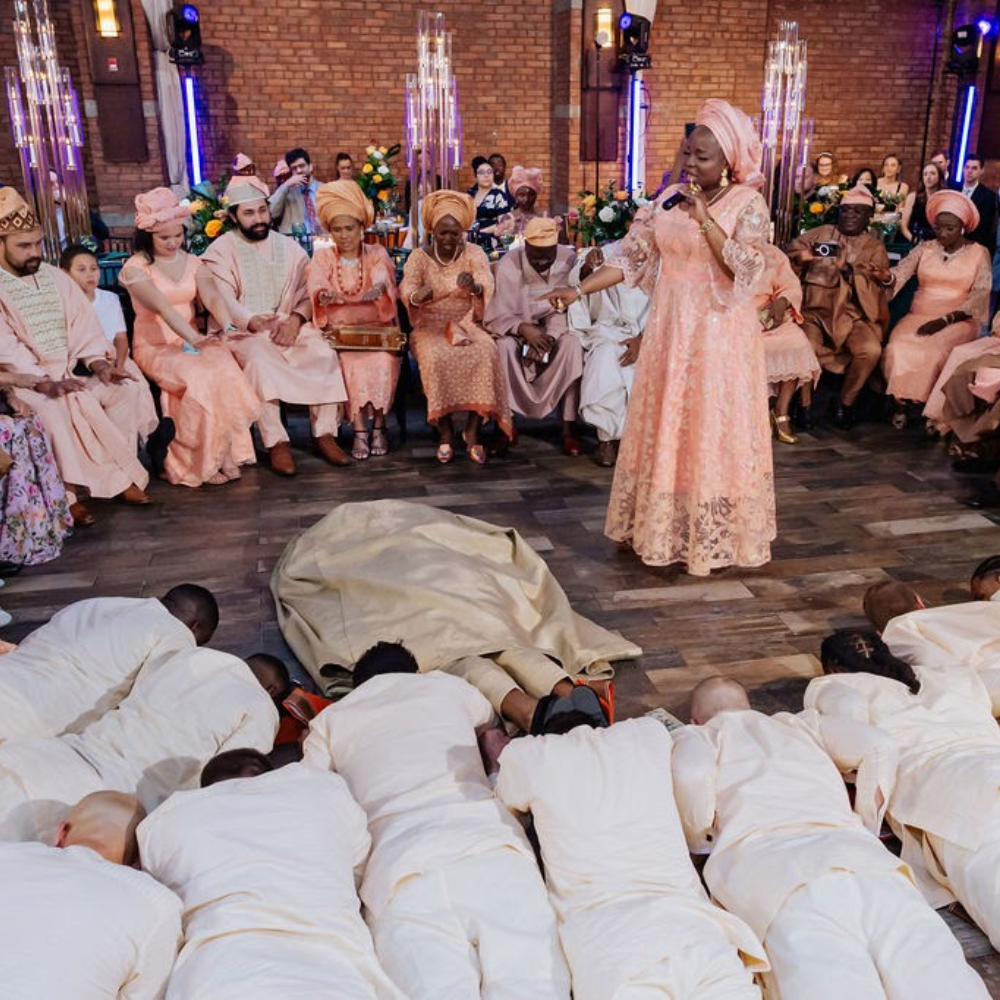
One of the most profound and emotionally charged rituals of the ceremony is the act of Idobale (prostration) for men and Ikunle (kneeling) for women. The groom and his male entourage enter the venue and perform
Idobale—lying flat on the ground with their arms straight out—to show profound respect to the bride’s parents and her family. This act is a symbolic representation of humility, selflessness, and the groom’s readiness to be a caring husband. The bride mirrors this gesture with
Ikunle as she seeks blessings from her parents and her new in-laws.
There exists a significant difference in the traditional meaning of Idobale and how it is perceived in modern contexts, particularly by those raised outside of traditional Yoruba culture. While a traditional Yoruba man views the act of prostration as an act of reverence and cultural identity, some from the diaspora or those with a more Westernized, individualistic mindset may perceive it as “humiliating” or imbalanced compared to the bride’s kneeling. This contrast highlights the evolving nature of tradition and the potential for a clash between communal, hierarchical values and a focus on individual autonomy. The prostration is not merely a gesture; it is a profound test of a man’s willingness to embrace and submit to the social structure of his new family. It is a powerful act that lays the foundation for a marriage rooted in respect for elders and community solidarity.
The Unveiling, Acceptance, and Exchange of Letters
The ceremony also features several other pivotal moments. The bride makes a grand entrance, often veiled and accompanied by her friends. She dances to show her happiness and kneels before both her parents and her future in-laws to receive their blessings. A key ritual is the cap-placing, where the bride is asked to find her groom in the crowd and place his cap on his head, a gesture that formally signifies her acceptance of his marriage proposal.
The union is further formalized through the ceremonial exchange of letters. The groom’s family presents a formal proposal letter, which is read aloud by a representative, officially requesting the bride’s hand in marriage. The bride’s family responds with an acceptance letter, which officially seals the agreement and signifies their blessings for the union. These letters, often written on beautifully designed stationery, are more than just formalities; they are foundational documents that represent a public declaration of love, commitment, and familial unity. The entire sequence—the presentation of the
Eru Iyawo, the reading of the proposal letter, and the response with the acceptance letter—is a carefully choreographed flow of events that cements the bond between the two families.
The Aesthetics and Semiotics of Celebration
The Language of Fabric: Aso-Oke and Aso-Ebi
The visual splendor of the Yoruba wedding is a critical element of the celebration. The traditional attire is a powerful form of non-verbal communication, with the choice of fabric and style conveying identity, social status, and communal bonds. The couple and their immediate families often wear
Aso-Oke, a handwoven cloth that is considered the “pinnacle of all fabrics” and a symbol of royalty and prestige. The three main types of
Aso-Oke—Alaari (deep red), Etu (dark blue), and Sanyan (light brown/tan)—each have distinct colors and associated symbolism, conveying wealth, purity, and tradition. The use of metallic synthetic threads to create a “shining” effect is a modern interpretation of a Yoruba aesthetic that associates reflectivity and light with “wealth, health, and high social status”.
The Aso-Ebi tradition, which translates to “family cloth,” is a potent visual statement of group solidarity. Guests, including family members and friends, wear coordinated attire to show their relationship to the celebrants and their support for the union. The choice of fabric—which can include lace, Ankara, Adire, or velvet—and color is meticulously chosen by the families, creating a vibrant and coordinated aesthetic. The
Gele, an elaborately styled headwrap, is an essential accessory that complements the outfits and further enhances the visual grandeur.
Type of Aso-Oke | Color & Material | Significance & Symbolism |
Etu | Dark blue or striped, often with a speckled tonal effect resembling a guinea fowl. | Represents prestige, tradition, and a deep-rooted connection to cultural heritage. |
Alaari | Deep red, handspun silk. | Perfect for a bold and regal appearance, symbolizing a powerful and elegant statement. |
Sanyan | Light brown or tan, often made of undyed silk. | Conveys a soft, classic, and elegant look, associated with wisdom and purity. |
The Talking Drum as a Speech Surrogate
Music is an integral part of every Yoruba celebration, and the talking drum (Dundun) holds a special place in the wedding ceremony. Skilled drummers are not merely musicians; they are cultural storytellers who can use the drum to mimic human speech, communicating praises (
Oriki), proverbs, and even humor. The talking drummer often engages in a rhythmic dialogue with the
Alagas, punctuating their speeches and amplifying the emotions of the moment. This practice reinforces the Yoruba belief that the drum is a “speech surrogate” and can effectively communicate with those who understand its language.
The Owambe Experience
The celebratory spirit of the Yoruba wedding is captured by the term Owambe, which literally means “the presence of a celebration”. This term encapsulates the extravagance, abundance, and vibrant atmosphere of the event. A defining feature of
Owambe is the copious amount of food and drink on offer, with a wide array of staple dishes such as Jollof rice, pounded yam with Egusi soup, and Amala with Gbegiri and Ewedu. Guests are also treated to a variety of snacks, referred to as “small chops,” and drinks like
Zobo, a refreshing hibiscus drink.
Another unique and popular tradition is the practice of “spraying” money, where guests throw or place currency notes on the couple or performers as a sign of appreciation and support. This gesture is a public display of solidarity and joy, further reinforcing the communal and celebratory nature of the event.
The Post-Liminal Stage and Modernity: Continuity and Change
The final stage of the rite of passage involves the bride’s incorporation into her new life and family. Historically, this phase included a ritual known as
Ekun Iyawo, or “the crying of the new bride”. This cry, which would take place on the eve of the wedding, was a solemn expression of a bride’s sorrow at leaving her parents’ home for an unfamiliar new life. This custom has largely faded due to societal shifts, with modern brides and their families expressing joy and eagerness rather than sadness. The decline of this ritual, along with other historical practices such as arranged marriages and child betrothal , is a direct result of broader societal forces. The influence of Westernization, education, inter-marriage, and the digital media has contributed to these changes, revealing a clear cause-and-effect relationship between globalization and the evolution of cultural customs.
Modern Yoruba weddings have also adapted to a more contemporary, urbanized lifestyle. The traditional setting of a family compound (Igbagede) has been largely replaced by large, modernized event centers. A popular trend is for couples to have a “double ceremony,” holding the traditional wedding and a “white” (church or court) wedding on the same day to accommodate busy schedules. This fusion allows couples to honor their heritage while embracing modern customs.
Despite these changes, the core values and foundational principles of the Yoruba wedding remain intact. The emphasis on family unity, the public declaration of commitment, and the celebration of community bonds continue to define the matrimonial experience. The rituals may evolve, and the venues may change, but the central purpose—to formalize the union of two families and to publicly celebrate the transition of two individuals—endures.
Conclusion: The Living Tradition
The traditional Yoruba wedding is a dynamic and living tradition, rich with layers of meaning and cultural significance. Far from being a static relic of the past, it is a vibrant institution that has successfully navigated the complexities of modernization while preserving its essential core. By examining the wedding through the framework of a rite of passage, one can appreciate that its rituals, from the initial negotiations to the final celebratory Owambe, are not arbitrary. Instead, they are deliberate, symbolic acts designed to facilitate a social and familial transformation.
The aesthetic elements, such as the Aso-Oke and Aso-Ebi, function as visual narratives, communicating wealth, status, and community solidarity. The verbal exchanges of the Alagas and the percussive praises of the talking drums serve as a ritualized performance of communal support and welcome. While the influence of globalization and urbanization has led to the decline of certain historical customs and a shift towards grander, more commercialized spectacles, the fundamental values of family unity, respect for elders, and a deep-rooted commitment to community continue to be the heart of the Yoruba matrimonial experience. The traditional Yoruba wedding stands as a testament to the resilience of a culture that can honor its past while confidently embracing its future.










Related Posts


Stay Informed With the Latest & Most Important News
Previous Post
Next Post

Advertisement