Now Reading: A Pantheon of Greatness: The Enduring Triumphs and Legacies of Nigerian Sports Legends
-
01
A Pantheon of Greatness: The Enduring Triumphs and Legacies of Nigerian Sports Legends
A Pantheon of Greatness: The Enduring Triumphs and Legacies of Nigerian Sports Legends

I. Introduction: The Heartbeat of a Nation
A. Report Overview and Thesis
This report undertakes a detailed examination of Nigerian sports legends, moving beyond a simple catalog of their achievements to explore their profound impact on national identity and global standing. The central thesis is that the narratives of these athletes are not merely chronicles of sporting success but powerful and nuanced stories of resilience, cultural ambassadorship, and the intertwined relationship between individual triumph and collective pride. Through an analysis of their careers across different eras and sports, this document will highlight shared themes of perseverance, overcoming adversity, and a deep-seated commitment to philanthropy and community development. The report aims to serve as an authoritative reference, providing a comprehensive and expert-level understanding of the figures who have shaped Nigeria’s sporting heritage.
B. Contextual Framing: The Socio-Cultural Significance of Sports in Nigeria
Sport holds an unparalleled place in the social fabric of Nigeria, serving as a unifying force and a crucial arena for national expression. The history of Nigerian sports is deeply linked to the country’s broader political and social development. Early figures, such as Harding J. Ekperigin, born in 1913 in Ugbori, Delta State, laid the groundwork for modern athletic pursuits. Known as the “father of physical education” in Nigeria, Ekperigin’s contributions were foundational; he studied physical education in England, authored several books on the subject, and was instrumental in reviving the curriculum of the Physical Education Teacher Training College in Ibadan. Another early hero, Teslim Balogun, was a pioneering figure in Nigerian football. These pre-colonial and early post-colonial heroes established a foundation upon which future generations would build. Sport became a powerful vehicle for demonstrating national capability and pride, and the triumphs of its heroes resonated deeply with a population eager to assert its place on the world stage. This historical backdrop is essential for understanding the immense weight and cultural significance carried by the achievements of the legends to be profiled.
II. The Kings of the Pitch: Football’s Vanguard
Football commands an unparalleled passion in Nigeria, and its legends are celebrated as national icons. This chapter analyzes the careers of figures who not only defined the Super Eagles but also left an indelible mark on the global stage through their unique talents and personal journeys.
A. Nwankwo Kanu: The Symbol of Resilience and a Humanitarian’s Legacy
Nwankwo Kanu’s career is a testament to extraordinary talent and unyielding perseverance. His journey to legendary status began early, with a pivotal role in Nigeria’s triumph at the 1993 FIFA U-17 World Championship in Japan, where he, alongside captain Wilson Oruma, led a team that shocked the world to lift the trophy. This early success paved the way for his signing with Dutch powerhouse Ajax, where he became a key player, winning an unprecedented three consecutive Dutch League titles, a UEFA Champions League medal, and the World Club Cup. His crowning moment with the national team came in 1996 when he captained the Nigerian U-23 “Dream Team” to a historic Olympic gold medal in Atlanta. A particularly memorable highlight from that tournament was his match-winning goal against Brazil in the semi-finals. Kanu’s trophy haul is among the most impressive in football history, making him one of the few players to have won the Premier League, FA Cup, Champions League, UEFA Cup, and an Olympic gold medal.
However, this journey was defined by a life-threatening challenge. Shortly after the 1996 Olympics, a medical examination at Inter Milan revealed a serious heart defect, with doctors believing his career was over. In a remarkable act of compassion and faith, Inter president Massimo Moratti kept Kanu on and funded a risky operation to replace an aortic valve. This event was not just a career setback but a profound personal crisis, one that his wife, Amara, first detected when she noticed his irregular heartbeat. Kanu’s faith as a Christian was a source of great strength during this period, and he has often spoken of his gratitude to Moratti. This experience was a turning point, directly inspiring him to found the Kanu Heart Foundation, an organization dedicated to helping young African children with heart defects. His personal health crisis was thus transformed into a powerful philanthropic mission, cementing his legacy as a humanitarian. He continues to be a public figure, not only for his sporting achievements but also for his commitment to service, a powerful narrative of turning personal adversity into a mission to save the lives of others.
B. Jay-Jay Okocha: The Artist of the Game
Augustine Azuka Okocha, widely known as “Jay-Jay,” represents a different kind of legend—one defined by audacious flair, creativity, and a style of play that transcended the tactical rigidities of his era. He is regarded as one of the most influential dribblers in world football history. His confidence and clever trickery on the ball, combined with his close control, turns, and signature stepover, made him a captivating figure. The most iconic example of his artistry is his legendary goal against Karlsruher SC, where he mesmerized goalkeeper Oliver Kahn and multiple defenders, a feat so spectacular that it was voted the 1993 Goal of the Year in Germany. His approach to the game, characterized by a freedom that defied structure, was pure chaos for defenders and a source of joy for fans.
Okocha’s career took him across Europe, from Germany to Turkey, and eventually to Paris Saint-Germain, where he was signed for a then-record £14 million, making him the most expensive African player at the time. His time at PSG was also notable for his mentorship of a young Ronaldinho, who would later become a Ballon d’Or winner and carry the torch of creative, entertaining football. At Bolton Wanderers, Okocha became a beloved captain and a Premier League Player of the Month, famously steering the team away from relegation with his clutch goals and leadership. While he may not have won a Ballon d’Or, Okocha won the hearts of millions by demonstrating that football could be an art form. His legacy contrasts with more decorated players like Kanu; Okocha’s value lay in his intangible flair and ability to entertain, while Kanu’s was rooted in tangible team success and leadership. The fact that a player like Okocha, who prioritized self-expression and skill over a purely utilitarian approach, is celebrated as one of Nigeria’s greatest footballers, underscores the nation’s appreciation for individual genius and creativity on the pitch.
C. Other Football Icons: Defining the Super Eagles
Nigeria’s football history is rich with other legendary figures who contributed significantly to the sport’s identity in the country. Rashidi Yekini, known as the “Goal King,” was a prolific striker and is the Super Eagles’ all-time highest goalscorer with 37 goals from 58 caps. His career spanned from 1981 to 2005, and he remains a powerful symbol of scoring prowess.
Christian Chukwu and Stephen Keshi represent a legacy of leadership. Chukwu, the team captain who won the 1980 Africa Cup of Nations, mentored Keshi, who followed in his footsteps by lifting the AFCON trophy 14 years later. This passing of the torch from one captain to another highlights a continuity of excellence and a strong tradition of defensive leadership within Nigerian football.
Segun Odegbami, a utility player for Shooting Stars from 1974 to 1984, was a member of the 1980 Nations Cup-winning team. He also holds an HND in mechanical engineering from Ibadan Polytechnic and has made contributions to youth development, organizing the first Milo under-13 soccer championship. While his achievements are significant, some recent comments from fans suggest that modern players are sometimes rated above older players like Odegbami, providing a nuanced perspective on generational comparisons and the evolving perception of greatness.
III. Track & Field’s Trailblazers: A Legacy of Speed and Leaps
Nigerian athletes have achieved global recognition in individual track and field events, but their stories are often defined by a duality of extraordinary triumph and profound challenge. This chapter explores the careers of three prominent women who exemplify this complex narrative.
A. Chioma Ajunwa: The Unyielding Pioneer
Chioma Ajunwa’s journey is a powerful testament to resilience. Her path to athletic greatness was unconventional; she initially played as an attacker for the Nigerian women’s football team, the Falcons, and was part of the 1991 Women’s World Cup squad. However, due to being constantly benched by her coach, she left football to pursue a career in track and field.
Her athletic career, specializing in the long jump, 100 m, and 200 m, began with success, including a bronze medal in the 4x100m relay at the 1990 Commonwealth Games and gold at the 1991 All Africa Games. This promising start was brutally interrupted in 1992 when she was banned from the sport for four years after failing a drug test, despite her persistent claims of innocence. After serving her full suspension, Ajunwa made a historic comeback. At the 1996 Atlanta Olympics, she became the first West African woman and the first Nigerian to win an Olympic gold medal in a track and field event. Her gold-medal winning jump of 7.12 meters was a landmark achievement, a personal victory that symbolized the breaking of barriers for her country.
The triumph, however, was accompanied by a sense of national neglect. In a 2003 interview, Ajunwa expressed bitterness, stating that she felt “dumped” and “treated like a scourge” by the country for which she had toiled so much. She also voiced frustration over being overlooked in comparison to the Nigerian football team, which had also won gold. This complex relationship between the athlete’s sacrifice and the nation’s gratitude highlights a significant paradox: a pioneer who brought unprecedented glory was not afforded the commensurate honor she felt she deserved. This experience, however, forged a lasting legacy. Ajunwa’s personal ordeal with the drug ban led her to become a vocal anti-doping advocate, launching a campaign titled “Compete Fair & Clean” to communicate messages directly to athletes and coaches. Her journey demonstrates how a career-threatening challenge can be transformed into a powerful mission to promote integrity within the sport.
B. Tobi Amusan: Breaking the Barrier
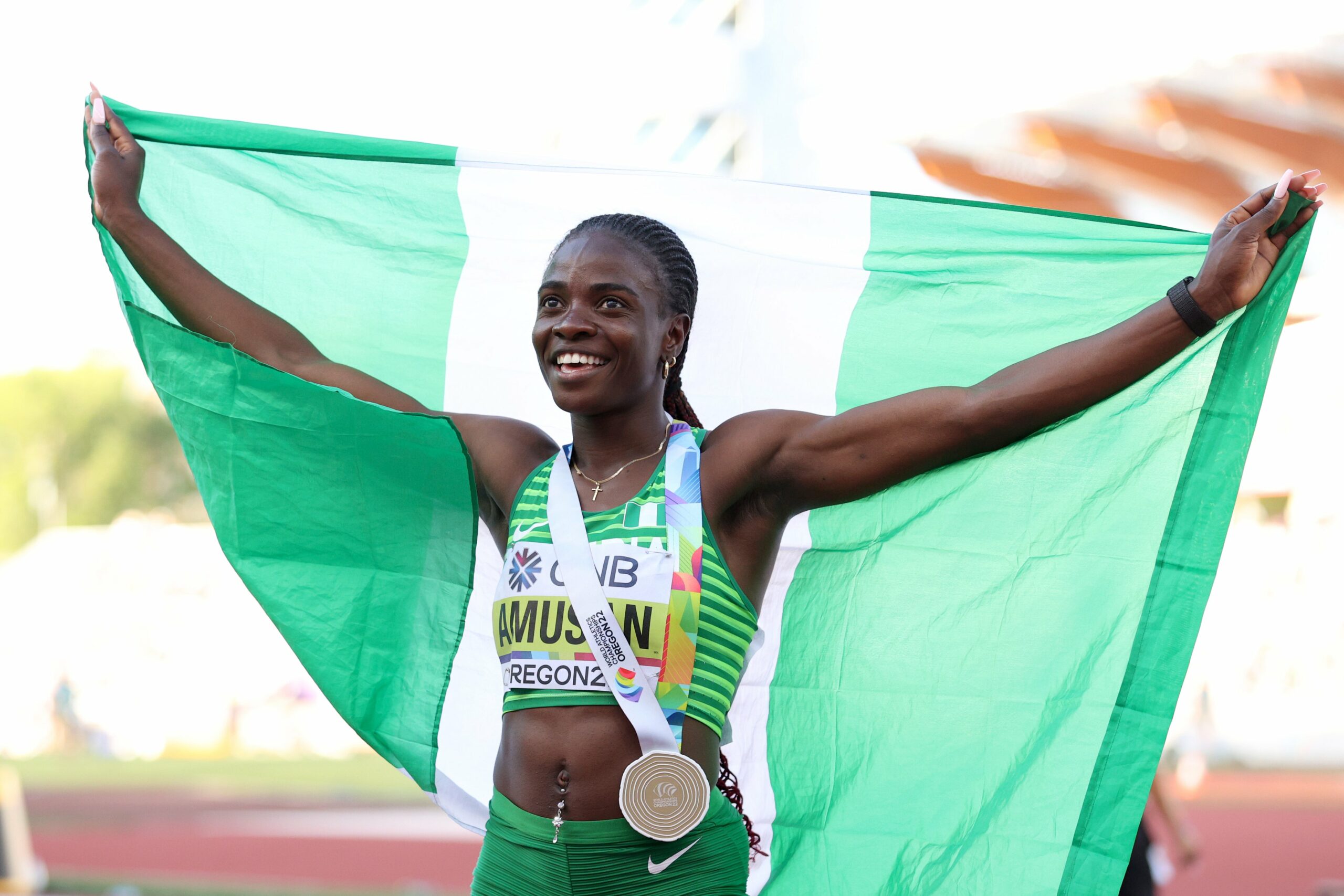
Tobi Amusan’s ascent to global stardom is a modern narrative of breaking barriers and proving her place among the elite. A hurdler by discipline, Amusan has amassed an impressive list of titles, including back-to-back Commonwealth and African titles in the 100m hurdles in 2018 and 2022. She also holds multiple Diamond League championships.
Her most iconic moment came at the 2022 World Championships in Eugene, Oregon. In the semi-final, she set a new world record in the 100m hurdles with a time of 12.12 seconds, becoming the first Nigerian world champion and world record holder in an athletics event. The achievement was followed by a 12.06-second run in the final, which, while an incredible performance, was not eligible for a world record due to a tailwind exceeding the legal limit of 2 m/s. The initial confusion and shock of commentators over what appeared to be two world records in one night underscored the magnitude of her performance. This rapid, unprecedented success brought immediate and intense scrutiny. Amusan was later charged by the Athletics Integrity Unit with anti-doping violations, but she was subsequently cleared of all charges by a disciplinary tribunal, a decision that was upheld after appeals were rejected by the Court of Arbitration for Sport. Amusan’s story is a modern-day triumph over the immense pressure and suspicion that often follows exceptional athletic success, particularly for athletes from non-traditional sporting powers. Her vindication adds a powerful layer to her legacy, solidifying her status as a Nigerian legend who proved her merit in the face of intense public scrutiny.
C. Blessing Okagbare: The Pinnacle and the Downfall
Blessing Okagbare’s career presents a contrasting and cautionary tale within the pantheon of Nigerian track and field. A decorated athlete, she achieved significant success, including an Olympic silver medal in the long jump at the 2008 Beijing Olympics and a Commonwealth Games gold medal. She was a consistent leader on the Nigerian team, leading the squad at major international competitions.
However, her career came to a dramatic and definitive end in 2022. The Athletics Integrity Unit (AIU) banned Okagbare for a total of 10 years for “multiple breaches of the Anti-Doping Rules”. The ban was bifurcated: five years for the use of two prohibited substances—human Growth Hormone (hGH) and recombinant erythropoietin (EPO)—and an additional five years for her refusal to cooperate with the AIU’s investigation. The Disciplinary Tribunal concluded that her use of the substances was part of an “organised doping regimen” and described her conduct as “egregious,” warranting the severe sanction. The AIU also noted that she was identified as “Athlete 1” in a US criminal complaint against her alleged supplier, highlighting the systemic nature of the issue. The stark contrast between her story and that of Ajunwa, who was vindicated after her ban, or Amusan, who was cleared of charges, underscores the differing ways athletes can navigate adversity. Okagbare’s documented fall from grace is a powerful cautionary tale about the importance of integrity in professional sports and the severe consequences of a conscious decision to cheat.
IV. The Warriors of the Ring and Octagon: Combat Sports’ Heavyweights
Nigerian fighters have demonstrated a unique brand of dominance in combat sports, with their careers often serving as powerful reflections of the nation’s political and social history.
A. The Boxing Legends: Hogan Bassey and Dick Tiger
The “Golden Age” of Nigerian boxing was defined by two world champions whose legacies are inextricably linked to the nation’s path to independence and its subsequent civil war. Hogan “Kid” Bassey became Nigeria’s first world champion in any sport in 1957, winning the featherweight title by stopping Cherif Hamia. His victory, occurring in the buildup to Nigeria’s independence in 1960, transformed him into a national hero. His success was widely seen as a symbol of unity and a sign that Nigeria had achieved political and cultural equality on the world stage. His triumph was lauded by political figures and the public alike as a significant contribution to the struggle for freedom.
In stark contrast, the career of Dick Tiger, a two-time undisputed world middleweight and light-heavyweight champion, took a different turn. While he was initially a lauded national hero after his 1962 victory , his public support for the Biafra Republic during the Nigerian civil war led to his “fall from grace”. This dramatic reversal in public perception illustrates how closely tied sporting heroes were to the political climate of the time. The differing fates of Bassey and Tiger serve as a powerful historical case study, demonstrating how triumphs in the ring could either symbolize national unity or become entangled in divisive political conflicts.
B. The New Breed: Israel Adesanya and Kamaru Usman
The modern era of combat sports is represented by two Nigerian-born fighters, Israel Adesanya and Kamaru Usman, who have achieved global superstardom in the Ultimate Fighting Championship (UFC). Usman became Africa’s first-ever UFC welterweight champion in 2019, followed only seven months later by Adesanya, who became the middleweight champion. Unlike their predecessors who were more tied to local politics, Adesanya and Usman represent a globalized Nigerian identity.
Both fighters were born in Nigeria but grew up abroad—Adesanya in New Zealand and Usman in the United States. They proudly embrace their Nigerian roots, regularly walking out to the music of Nigerian artists like Fela Kuti and Wizkid and performing the “shaku shaku” dance in the octagon. This visible and proud display of their heritage is not just a personal expression; it is a conscious act of cultural ambassadorship that has helped open the sport to a wider global audience, particularly in Africa. The duo has leveraged their immense influence to promote the idea of a UFC event being held in Africa. This dynamic shows how the new generation of Nigerian athletes, often with dual heritage, is redefining what it means to be a national hero in a globalized world. They are not only masters of their craft but also pioneers who use their platform to bridge cultures and inspire a new kind of diasporic pride.
V. Beyond the Conventional: Redefining Nigerian Sporting Identity
Some of Nigeria’s most celebrated legends achieved greatness in sports that were not traditionally dominant in the country, showcasing the depth and versatility of Nigerian athletic talent.
A. Hakeem Olajuwon: The Dream, The Icon
Hakeem Olajuwon’s journey from a soccer-playing youth in Lagos to one of the greatest centers in NBA history is a testament to extraordinary athletic adaptability. The footwork he gained from his early days playing soccer and team handball in Nigeria became the foundation for his legendary post moves, which were famously dubbed the “Dream Shake”. His unlikely journey culminated in him being selected as the No. 1 overall pick in the 1984 NBA Draft by the Houston Rockets, one spot ahead of Michael Jordan.
Over his 18-year career, Olajuwon amassed a remarkable list of accolades, including leading the Houston Rockets to two back-to-back NBA championships in 1994 and 1995. He was named the NBA’s MVP, Defensive Player of the Year, and Finals MVP in 1994, becoming the first player in NBA history to win all three in the same season. He holds the NBA record for blocked shots and is the only player to record more than 3,000 blocks and 2,000 steals. Olajuwon’s exceptional two-way dominance was highlighted in a 1987 performance where he came remarkably close to a quintuple-double, a feat never before and never since officially tracked.
Olajuwon’s legacy is multi-faceted, extending beyond the court. He is a cultural and religious ambassador who remained deeply connected to his Nigerian roots and openly embraced Islam. His commitment to his faith was demonstrated by his fasting during the months of Ramadan, which often fell during the NBA season, an act that showcased his discipline and refusal to make excuses. He used his platform for philanthropic work, investing in youth development, education, and sports infrastructure in Nigeria, and he also established the Islamic Da’wah Center in Houston to educate people about his faith. His career exemplifies a powerful integration of athletic excellence with personal values and community service.
B. Christian Okoye: The Nigerian Nightmare
Christian Okoye’s story is a testament to raw talent and determination, proving that a late start can still lead to lasting greatness. Okoye arrived in the United States at age 21, having previously excelled in track and field, winning seven college titles in the shot put, discus, and hammer throw. He had little interest in American football, finding the game boring and initially considering quitting due to its roughness. However, after being denied a spot on the Nigerian 1984 Olympic team, he took up the sport at Azusa Pacific University.
His rare combination of speed (a 4.45-second 40-yard dash) and size (6’1″, 260 lbs) led to his selection by the Kansas City Chiefs in the second round of the 1987 NFL draft. He quickly became known as “the Nigerian Nightmare” for his powerful running style and ability to break tackles. In 1989, he had his best season, leading the NFL in rushing attempts and yards, becoming the first Chiefs player to lead the league in rushing. His post-NFL career is marked by a continued commitment to community service through his Christian Okoye Foundation, which sponsors athletic programs and aims to motivate at-risk youth. His journey from an unwilling participant to a Hall of Famer in a sport he initially found boring is a powerful story of turning a challenge into a lasting legacy of inspiration.
VI. Thematic Synthesis and Legacy
A. Triumph Over Adversity: A Recurring Narrative
A central and unifying theme in the careers of Nigerian sports legends is the narrative of triumph over significant adversity. This shared experience is a hallmark of Nigerian athletic greatness, distinguishing these figures from their contemporaries. Kanu’s story of overcoming a life-threatening heart condition and turning his personal struggle into a humanitarian mission stands as a profound example of this theme. Similarly, Chioma Ajunwa’s perseverance through a four-year drug ban and her subsequent return to win Olympic gold demonstrates an indomitable spirit. On the other hand, the story of Christian Okoye, who had to redefine his entire athletic career after a late start and a disappointment with his national track team, illustrates triumph through adaptability and raw determination. Even a modern-day star like Tobi Amusan had to overcome skepticism and legal challenges to have her world record and integrity confirmed. This pattern suggests that greatness for these athletes was not a straight path but was often forged in the crucible of personal and professional challenges.
B. Pioneers, Mentors, and Cultural Ambassadors
The influence of these legends extends far beyond their professional achievements. Many have served as pioneers and mentors, using their platforms to inspire the next generation and give back to their communities. Jay-Jay Okocha, for instance, is remembered for mentoring a young Ronaldinho, showcasing a legacy of artistic inspiration that transcends national boundaries. Nwankwo Kanu’s founding of the Kanu Heart Foundation has provided life-saving surgeries for numerous children, a direct result of his own personal journey. Hakeem Olajuwon’s philanthropic work in Nigeria and his establishment of the Islamic Da’wah Center in Houston highlight a deep-seated commitment to faith and cultural ambassadorship. The modern combat sports icons, Israel Adesanya and Kamaru Usman, are using their global fame to proudly showcase Nigerian culture on a global stage, bridging the diaspora and inspiring a new sense of pride. This collective commitment to using their success for the greater good solidifies their status as national icons and cultural ambassadors.
C. The Intersection of Sport and National Identity
The careers of these legends are inextricably linked with the broader history and identity of Nigeria. The contrasting stories of Hogan Bassey and Dick Tiger serve as a powerful historical lesson, demonstrating how sporting success could either symbolize national unity or become entangled in political turmoil. Bassey’s victory in the lead-up to independence was a symbol of Nigeria’s readiness for the world stage, while Tiger’s support for Biafra during the civil war led to his tragic downfall in the eyes of the state. Similarly, Chioma Ajunwa’s feeling of being “dumped” despite winning the country’s only individual Olympic gold medal highlights the complex and often unequal relationship between an athlete’s sacrifice and the nation’s recognition. These narratives prove that sporting achievement in Nigeria is rarely confined to the stadium; it is a dynamic and evolving narrative that reflects the country’s hopes, struggles, and triumphs.
VII. Conclusion: An Enduring Legacy
The Nigerian sports legends profiled in this report are defined not merely by their records and medals but by their unique triumphs over adversity, their profound cultural impact, and their roles as trailblazers and philanthropists. From the artistic flair of Jay-Jay Okocha to the humanitarian mission of Nwankwo Kanu, the pioneering spirit of Chioma Ajunwa, and the global ambassadorship of Hakeem Olajuwon and the UFC champions, each narrative contributes to a rich, complex, and inspiring tapestry of national greatness. Their collective legacy is a dynamic and evolving story that continues to inspire new generations of athletes and citizens alike, proving that the true measure of a legend lies not just in what they achieve, but in who they become and how they use their success to shape the world around them.










Related Posts


Stay Informed With the Latest & Most Important News
Previous Post
Next Post

Advertisement