Now Reading: The Nigerian Civil War (Biafra War): A Comprehensive Analysis of its Origins, Conduct, and Enduring Legacy
-
01
The Nigerian Civil War (Biafra War): A Comprehensive Analysis of its Origins, Conduct, and Enduring Legacy

The Nigerian Civil War (Biafra War): A Comprehensive Analysis of its Origins, Conduct, and Enduring Legacy

I. Introduction to the Conflict
The Nigerian Civil War, also known as the Biafran War, remains a seminal and tragic event in the history of post-colonial Africa. Fought from July 6, 1967, to January 15, 1970, between the federal government of Nigeria and the secessionist state of Biafra, the conflict was a violent struggle for national unity and self-determination. The human cost was catastrophic, with estimates of the death toll ranging from 500,000 to 3,000,000 people, many of whom were civilians who perished from starvation. While the war is often framed as a straightforward conflict over secession, its origins are far more complex, rooted in the political and social fractures deliberately created and amplified by British colonial rule. This report provides a comprehensive, multi-faceted analysis of the war, examining the deep-seated historical grievances that precipitated it, the military and humanitarian dimensions of the fighting, the geopolitical interests that shaped international involvement, and the profound, unresolved legacy that continues to influence Nigeria’s political landscape today.
II. The Pre-War Crucible: Amalgamation, Ethnic Politics, and the Military’s Collapse
II.A. The British Colonial Legacy: A Foundation of Disunity
The foundations of the Nigerian Civil War were laid decades before the first shot was fired, during the era of British colonial administration. The amalgamation of the Northern and Southern Protectorates in 1914 was an act of “imperial convenience” and fiscal necessity, serving to offset the administrative costs of the less financially viable North with the surplus income from the South. This union was never geared toward fostering a genuine sense of national identity among the diverse ethnic groups it encompassed. Instead, it created a single administrative unit with a fundamental lack of cohesion.
Further exacerbating these divisions was the policy of “indirect rule,” which was applied with starkly different results across the country. In the North, the British governed through the existing, centralized authority of the Sokoto Caliphate, reinforcing the power of the Hausa-Fulani emirs. This system entrenched an authoritarian political culture where commoners were taught to submit to political leaders. In contrast, in the Southeast, where the Igbo people had no traditional system of paramount chiefs, the British imposed “warrant chiefs”—a form of authority lacking traditional legitimacy and despised by the local population. These divergent administrative models fostered deeply incompatible political cultures. The Hausa-Fulani viewed political leadership as a matter of subservience and loyalty, while the Igbos, with a history of direct participation in community affairs, saw the political system as an instrument for achieving personal goals. These opposing political philosophies, institutionalized by the British, meant that by the time of independence, Nigeria was not a cohesive nation but a conglomeration of peoples whose primary allegiance remained with their ethnic group rather than the Nigerian state itself. This pre-existing sense of division was openly manifested in the “Northernization policy,” which sought to exclude southern peoples from the civil service in the North, further hardening the lines between ethnic groups and creating resentment.
II.B. Post-Independence Tensions and the Descent into Violence
Following independence in 1960, the new Nigerian state inherited a political structure defined by its ethnic and regional fault lines. The country was segmented into three large geographic regions, each controlled by a dominant ethnic group: the North by the Hausa-Fulani, the West by the Yoruba, and the East by the Igbo. Regional leaders fiercely protected their privileges, and conflicts were endemic, with the South complaining of northern domination and the North fearing a southern elite takeover.
This fragile political balance was shattered by a series of military coups in 1966. In January, a group of largely Igbo junior army officers overthrew the civilian government, assassinating prominent northern politicians. Although the coup leaders were forced to cede power to the highest-ranking officer, an Igbo, Major General Johnson Aguiyi-Ironsi, the takeover was widely interpreted in the North as a tribal plot for Igbo domination. The military, rather than acting as a unifying national force, fractured along the very same ethnic lines it was supposed to supersede. This cycle of political violence culminated in a counter-coup in July 1966, led by northern officers, during which Aguiyi-Ironsi was assassinated and Lieutenant Colonel Yakubu Gowon was installed as the new head of state. The political crisis was compounded by large-scale massacres of Igbos in the North, a direct and brutal expression of the deep-seated anti-Igbo sentiments that had been building for years.
II.C. The Point of No Return: The Aburi Accord and Secession
In an attempt to stave off further conflict, Ojukwu and Gowon met in Aburi, Ghana, and signed an accord that would implement a looser Nigerian federation. However, the federal government under Gowon reneged on the agreement, and on May 27, 1967, proclaimed the division of Nigeria into twelve states. This decree was not a neutral act of administrative restructuring; it was a strategic maneuver that carved the Eastern Region into three parts, effectively placing the vast majority of the region’s oil resources outside of the new Igbo-dominated state. This move transformed a political and ethnic crisis into an open conflict for economic control. The federal government’s decision to initially allow oil tankers to bypass the blockade underscored the central role of petroleum in the conflict.
Feeling increasingly alienated and politically and economically cornered, the Eastern Region’s consultative assembly authorized Ojukwu to declare a sovereign republic. On May 30, 1967, Ojukwu declared the entire Eastern Region independent, renaming it the Republic of Biafra and adopting a new flag. The conflict was no longer a political dispute; it was a full-scale war for existence, a violent culmination of historical grievances and structural inequalities.
Table 1: Key Belligerents and International Support
| Belligerent | Leader(s) | Major International Supporters | Motivations of International Supporters |
| Nigerian Federal Government | General Yakubu Gowon | United Kingdom, Soviet Union, Egypt | Preserving oil interests (UK), gaining political and ideological influence (USSR) |
| Republic of Biafra | Lieutenant Colonel Chukwuemeka Ojukwu | France, China, Israel, Gabon, Haiti, Ivory Coast, Tanzania, Zambia | Economic interests in oil (France), ideological support for self-determination and covert aid (various countries) |
III. The Theatre of War: Military Campaigns and a Humanitarian Crisis
III.A. Military Campaigns and Strategies
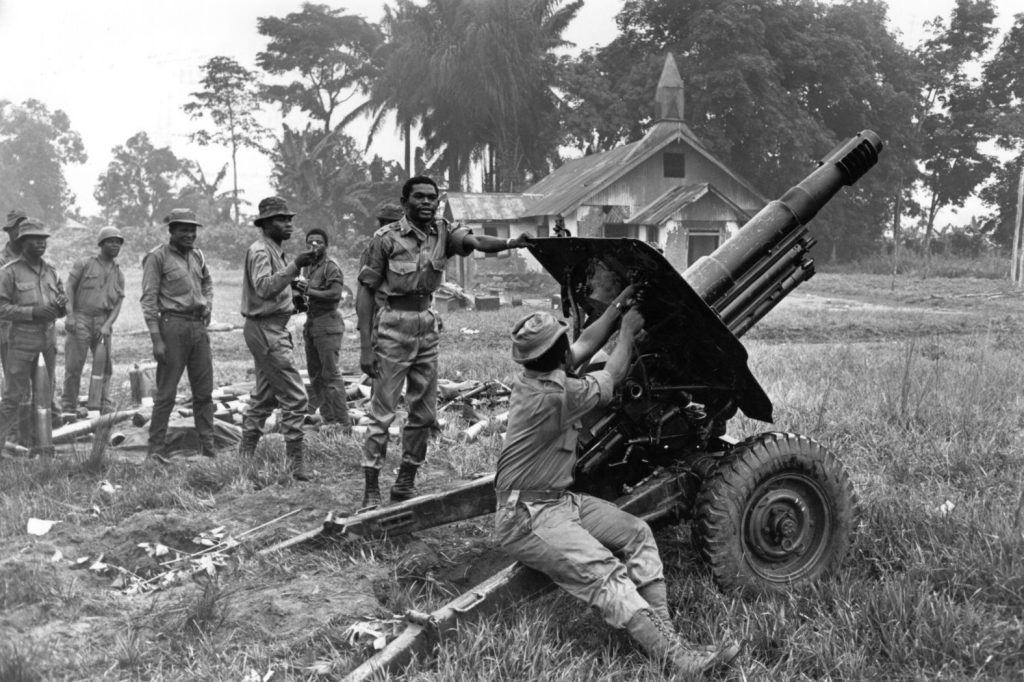
The war officially began on July 6, 1967, with Nigerian federal troops advancing into Biafran territory. In a surprising early counter-offensive on August 9, Biafran forces advanced west, crossing the Niger river and easily taking over the Mid-Western state with little resistance. They advanced as far as Ore, a town in the Western state, before being checked. This early success for Biafra, however, was a tactical rather than strategic victory. It served to tie down Nigerian troops and demonstrated the Biafran military’s capacity for offensive action, yet it failed to secure a lasting advantage.
The federal government responded by mobilizing its entire population, swelling its army from 7,000 to over 200,000 men by 1969. The Nigerian military employed a strategy of encirclement and blockade, systematically capturing coastal oil facilities and the city of Port Harcourt. The conflict settled into a stalemate between 1968 and 1969 until a final federal push in June 1969 reduced Biafran territory to a small enclave. Both sides utilized foreign mercenaries and propaganda to great effect. The under-equipped Biafran forces, starting with just a few hundred soldiers, relied on ambushes and improvised equipment from a unit known as the RAP to defend their shrinking territory.
III.B. The Blockade and the Strategy of Starvation
The most brutal and defining aspect of the conflict was the Nigerian federal government’s naval and air blockade of Biafra. The blockade, which cut off all access to seaports and airfields, deliberately interdicted the flow of food, medicine, and other essential supplies to the civilian population. Nigerian government leaders acknowledged that starvation was a “deliberate tactic of war” and dismissed reports of famine as “Biafran propaganda”. The blockade created a catastrophic humanitarian crisis, a severe famine that ultimately resulted in at least a million deaths, with most of the casualties being civilians, particularly children, who were extremely vulnerable to malnutrition.
The Biafran leadership, in a desperate attempt to protect its clandestine arms routes, rejected daylight aid flights and proposed aid corridors, arguing they could be used by the Nigerians to poison their population or enable bombing. This tragic trade-off between securing a means of armed resistance and saving a starving population underscored the desperate choices faced by the Biafran government. The deliberate use of starvation as a weapon, while not prohibited by international law at the time, sparked a global outcry. The outrage and mobilization of humanitarian organizations led directly to the 1977 amendments to the Geneva Conventions, which legally prohibited attacks on “objects indispensable to the survival of the civilian population,” marking a pivotal moment in the evolution of international humanitarian law.
IV. The Global Stage: Geopolitical Interests and the Birth of Modern Humanitarianism
IV.A. The Geopolitical Chessboard: Oil, Influence, and Ideology
The Nigerian Civil War was not an isolated internal conflict; it was a microcosm of Cold War dynamics and the global scramble for resources, with major world powers supporting their respective sides for strategic gain. The United Kingdom, Nigeria’s former colonial ruler, officially supported the federal government to preserve the multi-ethnic country it had created. However, the reality of its motivations was more complex. Britain’s primary concern was protecting its significant oil interests, particularly those of Shell-BP. The UK’s decision was also a calculated move to prevent the Soviet Union from gaining a foothold in the region, a possibility that arose when Nigeria, in need of aircraft, accepted a Soviet offer of MiG-17 fighters. This arms deal became a turning point, as it established a steady flow of Soviet weapons to Nigeria and prompted the UK to increase its own supply to maintain its influence in Lagos.
France, in contrast, provided covert support to Biafra. While its public position was rooted in the principle of self-determination, its actions were driven by a policy that was largely “anti-British, anti-Nigerian”. The French national oil company, SAFRAP, had exploration rights in the Niger River Delta, and supporting Biafra was seen as a way to secure its economic interests and challenge British hegemony. This complex web of alliances and rivalries demonstrates that the public justifications for foreign intervention were often a cover for the real motivators: oil and strategic influence.
IV.B. The Humanitarian Response and its Ethical Complexities
The widespread media coverage of the Biafran famine, particularly the images of starving children, galvanized a global humanitarian response of unprecedented scale. Petitions to the United Nations were largely ignored, as most national governments viewed the conflict as an internal Nigerian affair and adhered to a policy of non-interference. As a result, non-governmental humanitarian organizations stepped in to fill the void, giving rise to a new era of global humanitarian action.
The “Biafran Airlift” became the largest civilian airlift in history, a joint effort by Protestant and Catholic church groups that flew in over 60,000 tons of humanitarian aid on more than 5,300 missions. Operating from bases in places like Sao Tome, volunteer crews flew into the makeshift Uli airport at night, often under heavy fire from Nigerian forces who claimed the planes were smuggling weapons. The airlift is estimated to have saved over one million lives.
However, the humanitarian effort was not without its ethical dilemmas. Aid organizations were accused of prolonging the war by providing moral support and serving as a cover for arms shipments, which often ran on the same clandestine routes as the aid. The crisis exposed the limitations of traditional, state-centric humanitarianism, which demanded neutrality and non-interference. The frustration over the inability to respond to atrocities and provide aid without political constraints led to a major confrontation, with many aid workers from the French Red Cross resigning at the end of the war. A group of these doctors went on to form Médecins Sans Frontières (Doctors Without Borders), an organization founded on the principle that a doctor’s duty to provide medical aid to victims of conflict should override national or political boundaries. The Nigerian Civil War thus became a crucible for a new, more activist and politically aware form of humanitarianism.
Table 2: Timeline of Major Events
| Date | Event | Description |
| 1914 | Amalgamation of Northern and Southern Protectorates | British colonial administration merges two distinct regions for economic and administrative convenience. |
| 1960 | Nigerian Independence | Nigeria gains independence, inheriting a political structure with deep ethnic and regional divisions. |
| Jan 1966 | First Military Coup | A group of junior army officers, mostly Igbo, overthrow the government, leading to the assassination of prominent northern politicians. |
| Jul 1966 | Counter-Coup and Pogroms | Northern officers stage a counter-coup, assassinating the Igbo head of state and triggering widespread massacres of Igbos in the North. |
| Jan 1967 | Aburi Accord | Negotiations in Aburi, Ghana, yield an agreement for a looser Nigerian federation. |
| May 1967 | Creation of 12 States | The Nigerian federal government reneges on the Aburi Accord and divides Nigeria into 12 states, economically isolating the Igbo. |
| May 30, 1967 | Biafran Declaration of Independence | The Eastern Region declares itself the sovereign Republic of Biafra. |
| Jul 6, 1967 | Start of the War | The Nigerian Civil War officially begins with a federal offensive. |
| Aug 1967 | Biafran Offensive | Biafran forces seize Benin City and advance to Ore before being checked. |
| 1968-1969 | Stalemate and Humanitarian Crisis | The war reaches a stalemate as the Nigerian blockade creates a severe famine, leading to unprecedented international humanitarian aid. |
| Jun 1969 | Final Federal Push | The Nigerian military launches a final offensive, reducing Biafra’s territory to a small enclave. |
| Jan 12, 1970 | Biafran Surrender | Biafra’s forces surrender, and the war officially ends. |
V. The Post-War Legacy: The Unfulfilled Promise of “No Victor, No Vanquished”
V.A. The Official Narrative: Reconciliation and Reconstruction
Following Biafra’s surrender, Gowon declared that the conflict had ended with “no victor, no vanquished”. He introduced a policy of “Reconciliation, Rehabilitation, and Reconstruction” with the stated aim of reintegrating former Biafran citizens into a unified Nigeria. While the slogan was rhetorically powerful and projected a message of magnanimity, the reality of the post-war policies exposed a stark contradiction. The federal government implemented measures that effectively disenfranchised the Igbo population, treating them as a conquered people rather than reconciled citizens. A key example was the “£20 policy,” which limited the exchange of all old Biafran and Nigerian currency to a flat rate of £20 per bank account, regardless of the amount a person had saved. This single act effectively wiped out the life savings of millions of Igbos. Furthermore, Nigerian courts routinely refused to recognize contracts or legal proceedings from the Biafran period, further undermining the lives and livelihoods of the Igbo people.
V.B. The Lived Experience: Marginalization and Lingering Trauma
The official reconstruction policies, while “laudable and noble” on paper, were implemented in a “half-hearted” manner and were subtly designed to perpetuate the marginalization of the Igbo people. The Igbo were systematically excluded from the affairs of the country, particularly in government appointments, with only a tiny fraction of civil servants being re-absorbed after the war. This exclusion extended to the sharing of national resources and the allocation of infrastructure projects. As a result, the Igbo were largely left to rebuild their devastated land through individual and communal efforts.
Fifty years after the war, the narrative of Igbo marginalization remains a deeply entrenched part of their collective memory. The unaddressed loss of property, economic hardship, and exclusion from federal positions created lasting grievances. Gowon’s peacebuilding approach, which prioritized political stability and national unity over addressing structural inequalities, effectively created a form of “structural violence” that continues to this day. For the Igbo, the war is not just a historical event but a lived narrative of “hurt,” “injustice,” and systematic exclusion. This persistent sense of grievance has fueled the emergence of modern-day neo-Biafran secessionist groups, such as the Indigenous People of Biafra (IPOB) and the Movement for the Actualization of the Sovereign State of Biafra (MASSOB), who continue the struggle for self-determination that began more than half a century ago.
Table 3: Military and Humanitarian Casualties
| Category | Estimated Death Toll | Primary Cause | Source |
| Total Deaths | 500,000 to 3,000,000 | Famine, Gunshot | |
| Combatants Killed | 45,000 to 100,000 | Direct Combat | |
| Civilian Deaths | 1,000,000+ | Famine and Disease | |
| Igbo Children Killed | ~40% of all Igbo deaths | Starvation, Gunshot |
VI. Conclusion
The Nigerian Civil War was the violent and tragic culmination of a deeply flawed colonial inheritance. The British policy of amalgamation, driven by economic expediency, created an inherently unstable state where ethnic and regional identities superseded any sense of a shared national one. This structural flaw, exacerbated by post-independence political competition and a series of brutal military coups, made conflict all but inevitable. The war itself was defined not only by its military campaigns but by a deliberate and devastating humanitarian crisis born from the Nigerian government’s strategic use of a total blockade. The global response, while unprecedented in scale, exposed the ethical and philosophical limitations of traditional humanitarianism and gave rise to a new, more interventionist model of aid.
While the war successfully preserved the territorial integrity of Nigeria, its peace was built on a fragile and inequitable foundation. The official post-war rhetoric of “no victor, no vanquished” stands in stark contradiction to the lived experience of the Igbo people, who suffered systematic economic and political marginalization. The war’s unaddressed grievances persist today, manifesting in renewed calls for secession and highlighting the enduring challenge of genuine reconciliation. The lessons of Biafra are a poignant reminder that true national unity cannot be imposed by force but must be forged through a foundation of justice, equity, and a shared commitment to addressing historical wounds. The war’s enduring echoes serve as a potent case study in the complexities of post-colonial nation-building, and its legacy is a testament to the idea that a conflict’s end does not always signify the beginning of peace.










Related Posts


Stay Informed With the Latest & Most Important News

Advertisement