

Chinua Achebe
The Father of Modern African Literature
Discover the life, works, and enduring legacy of Chinua Achebe, the literary titan whose masterpiece Things Fall Apart reshaped global literature and reclaimed the African narrative.
Reclaiming the
African Narrative
Albert Chinụalumọgụ Achebe (1930–2013) is universally celebrated as the patriarch of the modern African novel. Born in the Igbo town of Ogidi in southeastern Nigeria during the British colonial era, Achebe was raised at the crossroads of traditional Igbo culture and Christian missionary influence.
While studying at the prestigious University of Ibadan, Achebe grew increasingly frustrated with the depictions of Africans in Western literature—most notably in Joyce Cary's Mister Johnson and Joseph Conrad's Heart of Darkness. This profound dissatisfaction fueled his desire to write back to the empire, telling the African story from the inside out.
The result was his 1958 debut novel, Things Fall Apart, a masterful tragedy documenting the collision of traditional Igbo society with British colonialism. Achebe not only birthed a literary masterpiece but laid the foundational blueprint for post-colonial African literature, serving as the founding editor of the influential African Writers Series.
- Cultural Authenticity: Rejecting the European "savage" trope for complex, flawed human characters.
- Language: Using a localized, proverb-rich English to capture the rhythm of Igbo speech.
- The Writer as Teacher: Believing literature must educate and rebuild the dignity of the African past.
A Legacy in Numbers
The scale of Achebe's literary impact
Explore the Legend
The different facets of Achebe's career
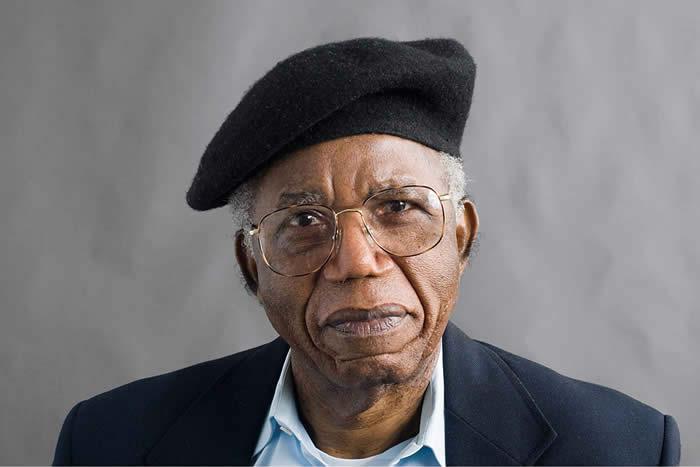
Chinua Achebe, whose works redefined the global understanding of African culture and history.
| 1958 | Things Fall Apart (Novel) |
|---|---|
| 1960 | No Longer at Ease (Novel) |
| 1964 | Arrow of God (Novel) |
| 1966 | A Man of the People (Novel) |
| 1975 | An Image of Africa (Seminal Essay on Conrad) |
| 1983 | The Trouble with Nigeria (Political Essay) |
| 1987 | Anthills of the Savannah (Novel) |
| 2012 | There Was a Country (Memoir) |
Themes & Impact
The core philosophies of Achebe's writing
Centered on the tragic hero Okonkwo, Things Fall Apart demystified the African continent for global readers. Achebe vividly portrayed a structured, complex Igbo society with its own laws, religion, and justice system, countering the colonial myth of Africa as a "dark continent" devoid of civilization before European arrival.
Achebe famously argued that the English language could be adapted to carry the weight of the African experience. Rather than writing strictly in Igbo (a stance taken by peers like Ngũgĩ wa Thiong'o), Achebe "Africanized" English, embedding Igbo proverbs, syntax, and rhythms into his prose to subvert the colonizer's tongue.
Beyond colonialism, Achebe was a fierce critic of post-independence Nigerian leadership. His novel A Man of the People eerily predicted Nigeria's first military coup, while his essay The Trouble with Nigeria squarely blamed the nation's failures on a failure of leadership, refusing national honors in protest of corruption.
Following a 1990 car accident that left him paralyzed from the waist down, Achebe relocated to the United States. He spent decades as a revered professor, holding the Charles P. Stevenson chair at Bard College and later the David and Marianna Fisher University Professorship at Brown University, shaping generations of global scholars.
Awards & Honors
Selected global recognition for Chinua Achebe
| Year | Award | Institution / Country |
|---|---|---|
| 1972 | Commonwealth Poetry Prize | Commonwealth Foundation |
| 1987 | Nigerian National Merit Award | Federal Republic of Nigeria |
| 2002 | Peace Prize of the German Book Trade | Börsenverein (Germany) |
| 2007 | Man Booker International Prize | Booker Prize Foundation (UK) |
| 2010 | Dorothy and Lillian Gish Prize | Gish Prize Trust (USA) |
| Honor | Institution |
|---|---|
| Honorary Fellowship | American Academy of Arts and Letters |
| Honorary Doctorate | Harvard University |
| Honorary Doctorate | Brown University |
| Honorary Doctorate | Dartmouth College |
| Honorary Doctorate | University of Cape Town |
Literary Archives
See also & internal links
Go deeper


